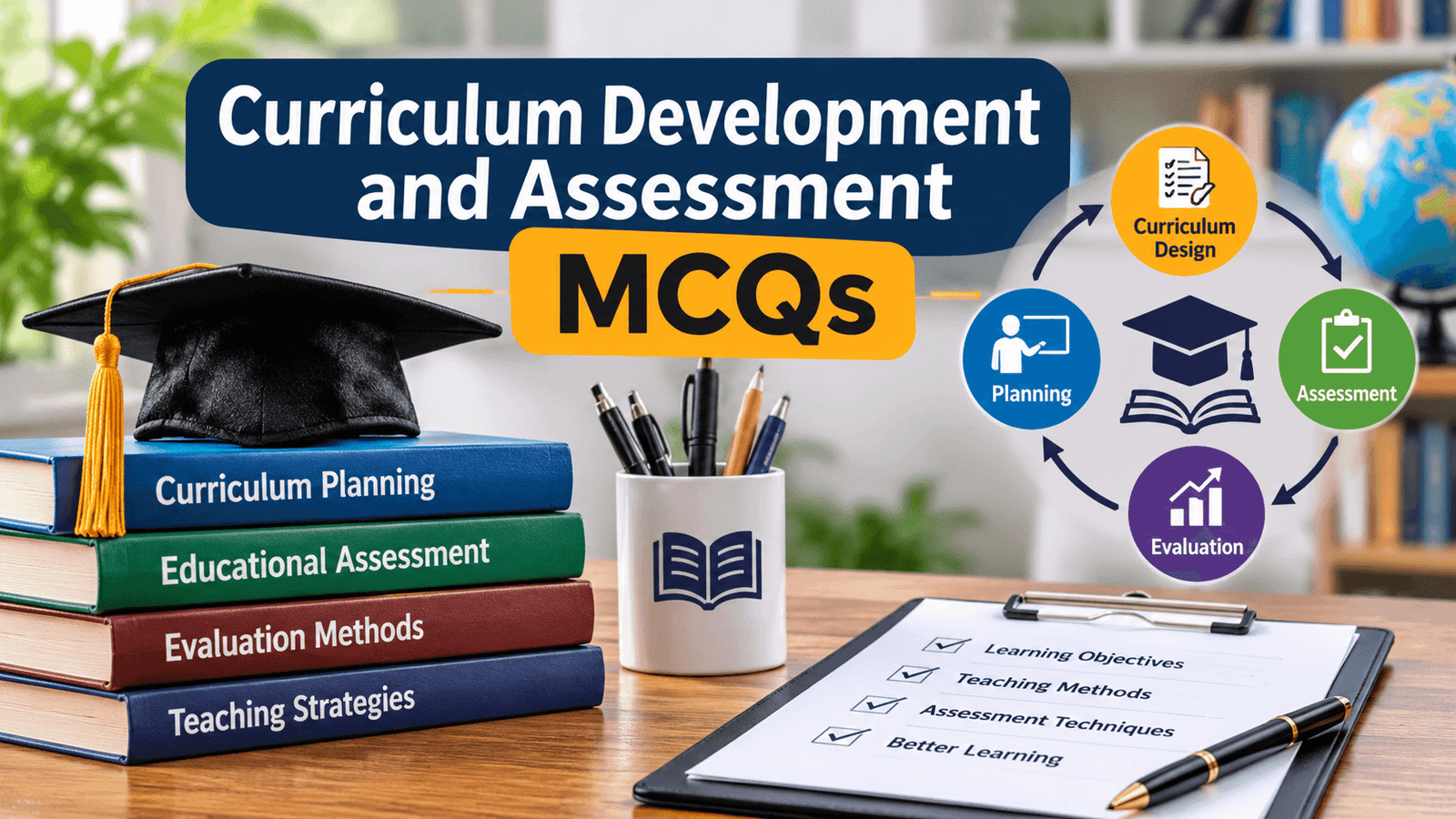
Curriculum Development and Assessment MCQs with Answers
Curriculum development and assessment are important components of the education system. They help teachers design effective learning experiences, establish educational objectives, and measure students’ academic progress. Understanding these concepts is essential for students, teachers, and candidates preparing for education-related competitive examinations in Pakistan.
This page provides useful practice material covering curriculum planning, educational evaluation, assessment techniques, instructional design, and learning outcomes. These topics are relevant to candidates appearing in PPSC, FPSC, NTS, CSS, PMS, SST, and other teaching recruitment examinations.
Importance of Curriculum Development in Education
Curriculum development is a systematic process of designing, organizing, implementing, and reviewing educational programs. It ensures that teaching activities are aligned with educational goals and students’ learning needs.
The process involves identifying objectives, selecting appropriate content, organizing learning experiences, and determining suitable evaluation methods. A well-designed curriculum improves the quality of education and supports students in achieving academic success.
Candidates preparing for educator recruitment tests should understand the basic principles of curriculum planning and educational organization.
Curriculum Planning and Design
Curriculum planning involves establishing educational objectives and selecting suitable learning activities. It considers students’ abilities, social requirements, institutional goals, and the needs of the education system.
Different curriculum designs are used in educational institutions. These include subject-centered, learner-centered, problem-centered, and integrated approaches.
Subject-centered design focuses on academic disciplines, while learner-centered design emphasizes students’ interests and individual abilities. Problem-centered approaches encourage learners to develop critical thinking and practical problem-solving skills.
Understanding these designs is useful for education students and candidates preparing for teaching examinations.
Educational Assessment and Evaluation
Assessment is the process of collecting information about students’ learning achievements. Evaluation involves interpreting this information to determine the effectiveness of educational activities and instructional methods.
Educational measurement, assessment, and evaluation are closely related concepts. Measurement provides numerical results, assessment gathers information about learning, and evaluation makes judgments based on collected evidence.
Important assessment methods include:
- Formative Assessment: Conducted during instruction to monitor learning progress.
- Summative Assessment: Used at the conclusion of a course or academic period.
- Diagnostic Assessment: Identifies learning difficulties and areas requiring improvement.
- Continuous Assessment: Evaluates students through regular academic activities.
- Criterion-Referenced Assessment: Measures performance against established standards.
These assessment techniques are frequently studied in teacher education and professional development programs.
Curriculum Evaluation and Learning Outcomes
Curriculum evaluation determines whether educational objectives have been achieved. It helps identify strengths, weaknesses, and opportunities for improving instructional programs.
Evaluation may involve student examinations, classroom observations, feedback, academic performance records, and other educational evidence.
Learning outcomes describe the knowledge, skills, and abilities students are expected to demonstrate after completing a lesson, course, or educational program.
Candidates should understand the relationship between educational objectives, instructional activities, and assessment methods. These concepts are useful for preparing education-related MCQs and recruitment examinations.
Important Curriculum Development Models
Several educational theorists have introduced models that guide curriculum planning and implementation.
Tyler’s model emphasizes educational objectives, learning experiences, organization, and evaluation. Taba’s model highlights teacher participation and a grassroots approach to curriculum development. Wheeler’s model presents curriculum development as a cyclical process.
Studying these models helps candidates understand how educational programs are designed and improved.
Curriculum theory also examines the philosophical, psychological, and sociological foundations of education. These foundations influence teaching strategies, educational objectives, and the selection of learning content.
Preparation for PPSC, FPSC, NTS, CSS, and PMS Exams
Candidates preparing for competitive examinations in Pakistan should revise essential educational concepts and practice objective-type questions regularly.
The study material on this page is relevant to:
- PPSC educator and teaching recruitment tests
- FPSC education-related examinations
- NTS teacher qualification tests
- CSS and PMS education preparation
- SST and secondary school teacher examinations
- Lecturer and subject specialist recruitment tests
Regular practice can improve conceptual understanding, accuracy, and confidence during examinations.
Benefits of Practicing Educational MCQs
Multiple-choice questions provide an effective method for reviewing important educational concepts. They allow candidates to identify knowledge gaps and revise challenging topics.
Practicing questions related to curriculum planning, assessment methods, educational measurement, and evaluation models can strengthen preparation for teaching examinations.
Candidates should focus on understanding concepts instead of memorizing answers. Reviewing incorrect responses and revisiting important theories can further improve learning outcomes.
Conclusion
Curriculum development and assessment are fundamental areas of educational studies. They support effective teaching, meaningful learning experiences, and the evaluation of academic achievement.
This MCQs collection on MCQsSite provides useful practice for students, educators, and candidates preparing for PPSC, FPSC, NTS, CSS, PMS, SST, and other competitive examinations in Pakistan.
Consistent practice, conceptual understanding, and regular revision can help candidates prepare effectively for their upcoming tests and improve their knowledge of educational principles.
Table of Contents
Prepare for PPSC, FPSC, NTS, CSS, PMS, SST, and other competitive exams with important Curriculum Development and Assessment MCQs with answers. Practice questions covering curriculum planning, educational assessment, evaluation methods, curriculum models, and teaching strategies to strengthen your exam preparation.
Thanks very much. Te article was very helpful
I REALLY APPRECIATE THE KNOWLEDGE SHARED
Thank you for visiting our site. We appreciate your interest and hope you found the information valuable. Please feel free to return anytime for updates and new content
The content was very helpful thank you
Thank you for visiting our site. We appreciate your interest and hope you found the information valuable. Please feel free to return anytime for updates and new content
vety good I appriciate you
Thank you for visiting our site. We appreciate your interest and hope you found the information valuable. Please feel free to return anytime for updates and new content
The content was very helpful. Thankful.