

Chapter # 3 – Understanding the Political System of Pakistan
SLO 3.2.3: Discuss Federal and Provincial Legislature of Pakistan (Bicameral Parliament, Provincial Assemblies and Gilgit-Baltistan Assembly)
Introduction
In a democratic country, laws are made by elected representatives. The institution responsible for making laws is called the legislature.
Pakistan has a federal parliamentary system in which legislative powers are divided between the Federal Legislature (Parliament) and the Provincial Legislatures (Provincial Assemblies). The Federal Legislature makes laws for the entire country, while Provincial Assemblies make laws for their respective provinces.
What is a Legislature?
A legislature is a law-making body whose members are elected by the people.
Main Functions of a Legislature
- Making laws.
- Debating national and provincial issues.
- Approving budgets.
- Representing the people.
- Monitoring the performance of the government.
Federal Legislature of Pakistan
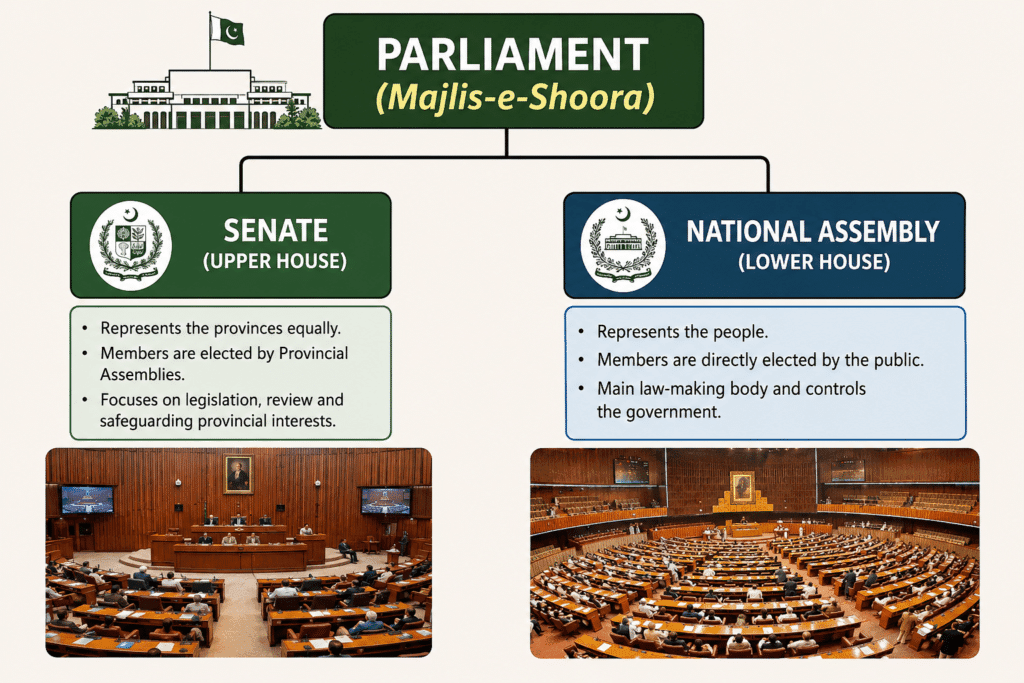
The Federal Legislature of Pakistan is called the Majlis-e-Shoora (Parliament).
Pakistan’s Parliament is bicameral, meaning it consists of two houses:
- National Assembly
- Senate
The President is also a constitutional part of Parliament.
What is a Bicameral Legislature?
A bicameral legislature is a legislature that has two houses.
The purpose of a bicameral system is to ensure that laws are carefully discussed and reviewed before approval.
Structure of Pakistan’s Parliament
National Assembly
The National Assembly is the lower house of Parliament and represents the people of Pakistan.
Members of the National Assembly (MNAs) are elected directly by the people through elections. The National Assembly debates and passes laws, approves the national budget, and holds the government accountable.
Functions of the National Assembly
- Makes federal laws.
- Approves the national budget.
- Elects the Prime Minister.
- Represents the people of Pakistan.
- Monitors the performance of the government.
Senate
The Senate is the upper house of Parliament and represents the provinces of Pakistan.
Unlike the National Assembly, the Senate provides equal representation to provinces regardless of their population size. This helps protect the interests of smaller provinces.
Functions of the Senate
- Participates in law-making.
- Reviews bills passed by the National Assembly.
- Protects provincial interests.
- Promotes national unity and harmony.
- Ensures balanced representation of provinces.
Why Does Pakistan Have a Bicameral Parliament?
Pakistan has a bicameral Parliament because:
- The National Assembly represents the population.
- The Senate represents the provinces equally.
- It protects smaller provinces from domination by larger provinces.
- It improves the quality of legislation through review and debate.
Provincial Legislatures
Each province in Pakistan has its own Provincial Assembly.
Provincial Assemblies make laws on matters assigned to provinces under the Constitution, such as education, health, agriculture, and local government.
Provinces with Provincial Assemblies
- Punjab Assembly
- Sindh Assembly
- Khyber Pakhtunkhwa Assembly
- Balochistan Assembly
What is a Unicameral Legislature?
A unicameral legislature is a legislature consisting of only one house.
All Provincial Assemblies in Pakistan are unicameral because each province has only one legislative chamber.
Functions of Provincial Assemblies
- Make provincial laws.
- Approve provincial budgets.
- Elect the Chief Minister.
- Discuss provincial issues.
- Monitor provincial government departments.
Gilgit-Baltistan Legislative Assembly
Gilgit-Baltistan also has its own legislative body known as the Gilgit-Baltistan Assembly.
It is a unicameral assembly consisting of elected representatives. The Assembly makes laws on matters related to Gilgit-Baltistan and discusses issues concerning the region.
Functions of the Gilgit-Baltistan Assembly
- Makes laws for Gilgit-Baltistan.
- Represents the people of the region.
- Approves regional policies and budgets.
- Holds the regional government accountable.
Difference Between Bicameral and Unicameral Legislature
| Bicameral Legislature | Unicameral Legislature |
|---|---|
| Has two houses | Has one house |
| Example: Parliament of Pakistan | Example: Provincial Assemblies |
| Includes Senate and National Assembly | Consists of a single assembly |
| Represents both people and provinces | Represents one administrative unit |
Structure of Legislatures in Pakistan
| Legislature | Type | Components |
|---|---|---|
| Parliament of Pakistan | Bicameral | Senate and National Assembly |
| Punjab Assembly | Unicameral | One House |
| Sindh Assembly | Unicameral | One House |
| Khyber Pakhtunkhwa Assembly | Unicameral | One House |
| Balochistan Assembly | Unicameral | One House |
| Gilgit-Baltistan Assembly | Unicameral | One House |
Importance of the Legislature
Representation of the People
Legislatures give citizens a voice through elected representatives.
Law-Making
They make laws necessary for the welfare and development of society.
Accountability
They monitor government actions and ensure transparency.
Democracy
Legislatures are essential institutions of democratic governance.
Key Terms
| Term | Meaning |
|---|---|
| Legislature | Law-making body of a country |
| Parliament | Federal legislature of Pakistan |
| Bicameral | Legislature with two houses |
| Unicameral | Legislature with one house |
| National Assembly | Lower house representing the people |
| Senate | Upper house representing provinces |
| Provincial Assembly | Legislature of a province |
| Gilgit-Baltistan Assembly | Legislative body of Gilgit-Baltistan |
Facts to Remember
Pakistan’s Parliament is bicameral.
It consists of the Senate and the National Assembly.
The National Assembly represents the people.
Its members are elected directly by the citizens.
The Senate represents the provinces.
It provides equal representation to federating units.
Provincial Assemblies are unicameral.
Each province has only one legislative house.
Gilgit-Baltistan has its own Legislative Assembly.
It makes laws and represents the people of the region.
Summary
The legislature is the law-making institution of a country. Pakistan’s Federal Legislature, called Parliament, is bicameral and consists of the National Assembly and the Senate. The National Assembly represents the people, while the Senate represents the provinces. Each province has a unicameral Provincial Assembly responsible for making provincial laws. Gilgit-Baltistan also has its own Legislative Assembly. Together, these institutions strengthen democracy, represent citizens, and ensure effective governance in Pakistan.
I am part of aKE
Thank you for visiting our site. We appreciate your interest and hope you found the information valuable. Please feel free to return anytime for updates and new content
Miss, you have shared a very useful link with us. It will help us understand and study the topics more better. Thank you so much!
AoA miss,
I’m student of your class.You made a better way to learn our syllabus much easier.
Thank you for your kindness.
Thank you for your thoughtful message. I’m pleased to know that the teaching approach is helping you learn the syllabus more easily. Keep up the good effort.
I am also part of AKE