

Chapter # 4 – Introduction to Geography
4.1.2locate Equator, Prime Meridian, Tropic of Cancer, Tropic of Capricorn,
Arctic Circle, Antarctic Circle, longitudes, and latitudes on the globe;
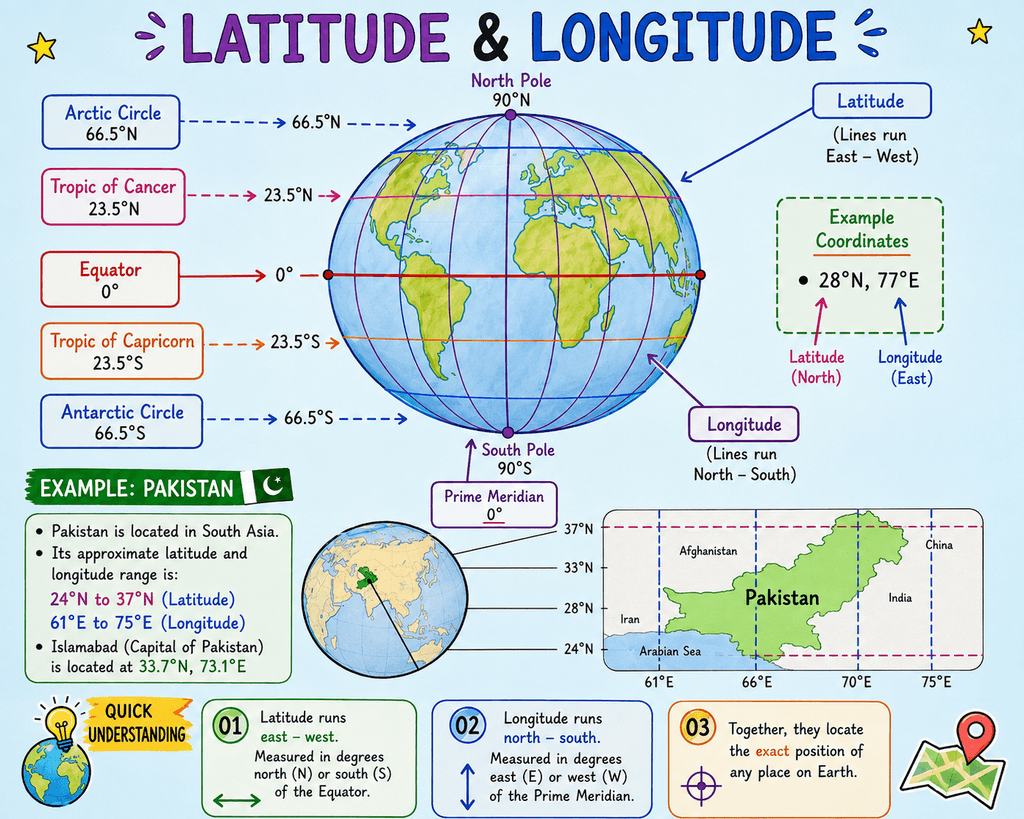
Equator
The Equator is an imaginary line that divides the Earth into the Northern Hemisphere and the Southern Hemisphere. It is located at 0° latitude and is the longest line of latitude on the globe. The Equator receives the most direct sunlight throughout the year and serves as the starting point for measuring latitude.
Prime Meridian
The Prime Meridian is an imaginary line that runs from the North Pole to the South Pole. It is located at 0° longitude and divides the Earth into the Eastern Hemisphere and the Western Hemisphere. The Prime Meridian passes through Greenwich, England, and is the starting point for measuring longitude.
Longitudes
Longitudes are imaginary lines that run from the North Pole to the South Pole. They are measured in degrees east or west of the Prime Meridian. Longitudes help determine the east-west position of places on the Earth and are used to calculate time zones.
Latitudes
Latitudes are imaginary lines that run parallel to the Equator. They are measured in degrees north or south of the Equator. Latitudes help determine the north-south position of places on the Earth and are important for studying climate and weather patterns.
Tropic of Cancer
The Tropic of Cancer is an imaginary line of latitude located at 23.5° North of the Equator. It marks the northernmost point where the Sun can appear directly overhead at noon. The Tropic of Cancer passes through several countries, including Pakistan.
Tropic of Capricorn
The Tropic of Capricorn is an imaginary line of latitude located at 23.5° South of the Equator. It marks the southernmost point where the Sun can appear directly overhead at noon. It passes through parts of South America, Africa, and Australia.
Arctic Circle
The Arctic Circle is an imaginary line of latitude located at 66.5° North of the Equator. It marks the southern boundary of the Arctic region. Areas within the Arctic Circle experience very long days in summer and very long nights in winter.
Antarctic Circle
The Antarctic Circle is an imaginary line of latitude located at 66.5° South of the Equator. It marks the northern boundary of the Antarctic region. Areas within the Antarctic Circle experience extreme seasonal variations in daylight and contain the continent of Antarctica.
Why are Latitudes and Longitudes Important?
Finding Locations
They help identify the exact location of places on Earth.
Navigation
Pilots, sailors, and travelers use them for navigation.
Climate Study
Latitudes help explain differences in climate and temperature.
Time Zones
Longitudes help determine local time around the world.
Key Terms
| Term | Meaning |
|---|---|
| Latitude | Imaginary line running east-west |
| Longitude | Imaginary line running north-south |
| Equator | 0° latitude dividing Earth into two hemispheres |
| Prime Meridian | 0° longitude dividing Earth into east and west |
| Tropic of Cancer | Latitude at 23.5° North |
| Tropic of Capricorn | Latitude at 23.5° South |
| Arctic Circle | Latitude at 66.5° North |
| Antarctic Circle | Latitude at 66.5° South |
| Hemisphere | Half of the Earth |
Facts to Remember
The Equator is located at 0° latitude.
It divides the Earth into Northern and Southern Hemispheres.
The Prime Meridian is located at 0° longitude.
It divides the Earth into Eastern and Western Hemispheres.
Latitudes run east to west.
They are parallel to the Equator.
Longitudes run from pole to pole.
They meet at the North and South Poles.
The Tropic of Cancer is at 23.5° North.
It passes through Pakistan.
The Arctic and Antarctic Circles are located at 66.5° latitude.
They mark the boundaries of the polar regions.
Summary
Latitudes and longitudes are imaginary lines used to locate places on Earth. The Equator (0° latitude) divides the Earth into Northern and Southern Hemispheres, while the Prime Meridian (0° longitude) divides it into Eastern and Western Hemispheres. Other important lines include the Tropic of Cancer, Tropic of Capricorn, Arctic Circle, and Antarctic Circle. These lines help geographers study location, climate, navigation, and time zones.
I am part of aKE
Thank you for visiting our site. We appreciate your interest and hope you found the information valuable. Please feel free to return anytime for updates and new content
Miss, you have shared a very useful link with us. It will help us understand and study the topics more better. Thank you so much!
AoA miss,
I’m student of your class.You made a better way to learn our syllabus much easier.
Thank you for your kindness.
Thank you for your thoughtful message. I’m pleased to know that the teaching approach is helping you learn the syllabus more easily. Keep up the good effort.
I am also part of AKE