

2.1.9 Mention the areas and princely states that became part of
Pakistan in 1947
Areas and Princely States that Became Part of Pakistan in 1947
Introduction
On 14 August 1947, Pakistan emerged as an independent state as a result of the partition of British India. The new country consisted of territories that had Muslim-majority populations and chose to join Pakistan under the provisions of the Indian Independence Act 1947.
Pakistan was created in two geographically separate regions:
- West Pakistan (present-day Pakistan)
- East Pakistan (present-day Bangladesh)
In addition to British Indian provinces, several princely states also acceded to Pakistan after independence. The inclusion of these areas helped shape the territorial boundaries of the new state.
Provinces that Became Part of Pakistan
At independence, Pakistan consisted of Muslim-majority areas from British India.
1. West Punjab
Punjab was divided between Pakistan and India by the Boundary Commission.
Areas Included in Pakistan
The western Muslim-majority districts became part of Pakistan.
Important cities included:
- Lahore
- Multan
- Rawalpindi
- Gujranwala
- Sialkot
- Faisalabad (Lyallpur)
Importance
West Punjab became the most populous province of Pakistan and played a central role in agriculture, administration, and economic development.
2. Sindh
Sindh became part of Pakistan as a whole province.
Major Cities
- Karachi
- Hyderabad
- Sukkur
- Larkana
Importance
Karachi served as the first capital of Pakistan and was the country’s main seaport.
Sindh provided Pakistan with access to the Arabian Sea, which was essential for trade and communication.
3. North-West Frontier Province (NWFP)
The North-West Frontier Province (now Khyber Pakhtunkhwa) joined Pakistan after a referendum held in July 1947.
Major Cities
- Peshawar
- Mardan
- Kohat
- Dera Ismail Khan
Importance
The province had a strategic location along the north-western border and served as an important gateway to Afghanistan and Central Asia.
4. British Balochistan
British Balochistan became part of Pakistan in 1947.
Important Areas
- Quetta
- Zhob
- Sibi
- Chaman
Importance
Balochistan was the largest province in terms of area and possessed significant mineral resources and strategic importance.
5. East Bengal (East Pakistan)
The eastern Muslim-majority part of Bengal became part of Pakistan and was known as East Pakistan.
Major Cities
- Dhaka
- Chittagong
- Mymensingh
- Rajshahi
Importance
East Pakistan contained a large population and was an important centre for agriculture, particularly the production of jute and rice.
In 1971, East Pakistan became the independent state of Bangladesh.
Princely States that Became Part of Pakistan
Besides British Indian provinces, several princely states acceded to Pakistan.
A princely state was a territory ruled by a local ruler under British supervision. At partition, these states were given the option to join either Pakistan or India.
1. Bahawalpur
Background
Bahawalpur was one of the largest princely states in the subcontinent.
It was ruled by Nawab Sir Sadiq Muhammad Khan Abbasi V.
Accession to Pakistan
Bahawalpur acceded to Pakistan on 5 October 1947.
Importance
- It was one of the first princely states to join Pakistan.
- The Nawab provided financial and administrative support to the new country.
- Bahawalpur later became part of West Pakistan in 1955.
2. Khairpur
Background
Khairpur was a princely state located in Sindh.
It was ruled by the Talpur Mirs.
Accession to Pakistan
Khairpur joined Pakistan in October 1947.
Importance
The state contributed to the territorial unity of Sindh and supported the new Pakistani state.
3. Swat
Background
Swat was a princely state located in the north-western region.
It was ruled by the Wali of Swat.
Accession to Pakistan
Swat acceded to Pakistan in 1947.
Importance
Swat became known for its administrative efficiency, educational reforms, and scenic beauty.
It was fully integrated into Pakistan in 1969.
4. Dir
Background
Dir was a princely state situated in the north-western mountainous region.
Accession
Dir joined Pakistan after independence.
Importance
Its accession strengthened Pakistan’s control over the north-western frontier region.
5. Chitral
Background
Chitral was located in the northern mountainous region bordering Afghanistan.
Accession
The ruler of Chitral decided to join Pakistan in 1947.
Importance
The state held strategic importance because of its location near important mountain passes.
6. Amb
Background
Amb was a small princely state located in present-day Khyber Pakhtunkhwa.
Accession
It acceded to Pakistan after independence.
Importance
Its accession further consolidated Pakistan’s territorial integrity.
Kalat and Other Baloch States
State of Kalat
Kalat was one of the most important princely states in Balochistan.
Initially, there were negotiations regarding its future status.
Eventually, Kalat joined Pakistan in 1948.
Importance
The accession of Kalat significantly increased Pakistan’s territorial area and strengthened its western borders.
Other Baloch States
The following states also became part of Pakistan:
- Kharan
- Las Bela
- Makran
These states acceded to Pakistan and later became part of Balochistan.
Areas that Did Not Become Part of Pakistan
Some Muslim-majority areas did not become part of Pakistan.
Jammu and Kashmir
Jammu and Kashmir had a Muslim-majority population but did not immediately accede to Pakistan.
Its future became the subject of dispute between Pakistan and India.
The Kashmir issue remains unresolved and continues to affect relations between the two countries.
Hyderabad Deccan
Hyderabad was a large princely state ruled by a Muslim Nizam but surrounded by Indian territory.
The state was eventually annexed by India in 1948 and did not become part of Pakistan.
Importance of the Accession of These Areas
The accession of provinces and princely states was important because:
Formation of a Viable State
These territories provided Pakistan with sufficient population, resources, and geographical area to function as an independent country.
Strategic Importance
Regions such as NWFP, Balochistan, Chitral, and Swat strengthened Pakistan’s strategic position.
Economic Development
Punjab, Sindh, and East Bengal contributed agricultural resources, industries, and trade opportunities.
National Integration
The accession of princely states helped unite diverse regions under one national government.
Conclusion
At independence in 1947, Pakistan consisted of West Punjab, Sindh, North-West Frontier Province, British Balochistan, and East Bengal. In addition, several princely states including Bahawalpur, Khairpur, Swat, Dir, Chitral, Amb, and later Kalat, Kharan, Las Bela, and Makran became part of Pakistan. These provinces and princely states provided the territorial foundation of the new country and played an important role in its political, economic, and strategic development.
Quick Revision
| Provinces that Became Part of Pakistan | Princely States that Joined Pakistan |
|---|---|
| West Punjab | Bahawalpur |
| Sindh | Khairpur |
| North-West Frontier Province (NWFP) | Swat |
| British Balochistan | Dir |
| East Bengal (East Pakistan) | Chitral |
| Amb | |
| Kalat (1948) | |
| Kharan | |
| Las Bela | |
| Makran |
Exam Question
Which provinces and princely states became part of Pakistan in 1947?
Pakistan initially consisted of West Punjab, Sindh, North-West Frontier Province, British Balochistan, and East Bengal. Several princely states also joined Pakistan, including Bahawalpur, Khairpur, Swat, Dir, Chitral, Amb, and later Kalat, Kharan, Las Bela, and Makran. These territories formed the geographical foundation of the new state of Pakistan.
2.1.10 locate the areas awarded to Pakistan by Boundary Commission on map of South Asia;
Areas Awarded to Pakistan by the Boundary Commission (1947)
Introduction
When British India was partitioned in 1947, the Boundary Commission, headed by Sir Cyril Radcliffe, was given the responsibility of drawing the boundaries between Pakistan and India. The commission worked mainly in the provinces of Punjab and Bengal, where both Muslims and non-Muslims lived in large numbers.
The final decision, known as the Radcliffe Award, determined which areas would become part of Pakistan and which would become part of India.
Understanding the areas awarded to Pakistan helps students understand the territorial formation of Pakistan and the challenges faced during partition.
What Was the Boundary Commission?
The Boundary Commission was established in June 1947 under the 3rd June Plan.
Its main responsibility was to:
- Divide Punjab between Pakistan and India.
- Divide Bengal between Pakistan and India.
- Draw new international boundaries.
The commission generally considered:
- Religious majority.
- Administrative convenience.
- Communication and transport links.
- Economic factors.
The final award was announced on 17 August 1947.
Areas Awarded to Pakistan in Punjab
The western Muslim-majority districts of Punjab became part of Pakistan.
Major Districts Awarded to Pakistan
Lahore District
- Lahore became part of Pakistan.
- It later became the capital of Punjab Province.
Gujranwala District
- Important agricultural and industrial region.
Sheikhupura District
- Located northwest of Lahore.
Sialkot District
- Important commercial and industrial centre.
Gujrat District
- Known for agriculture and trade.
Rawalpindi District
- Became an important military and administrative centre.
Jhelum District
- Located in northern Punjab.
Attock District
- Strategic district connecting Punjab and Khyber Pakhtunkhwa.
Mianwali District
- Located in western Punjab.
Sargodha District
- Major agricultural region.
Lyallpur District (Now Faisalabad)
- Important agricultural and industrial city.
Montgomery District (Now Sahiwal)
- Fertile agricultural region.
Multan District
- Historic city and trading centre.
Muzaffargarh District
- Located between the Chenab and Indus rivers.
Dera Ghazi Khan District
- Important district in southern Punjab.
Jhang District
- Agricultural region in central Punjab.
Areas Awarded to Pakistan in Bengal
The eastern Muslim-majority districts of Bengal became part of Pakistan and formed East Bengal (East Pakistan).
In 1971, East Pakistan became Bangladesh.
Major Districts Awarded to Pakistan
Dacca (Dhaka)
- Became the capital of East Pakistan.
Chittagong
- Major seaport.
Mymensingh
- Important agricultural region.
Rajshahi
- Major administrative centre.
Bogra
- Agricultural district.
Noakhali
- Coastal district.
Tippera (Comilla)
- Important commercial region.
Pabna
- Agricultural district.
Faridpur
- Located in central East Bengal.
Jessore (Most Parts)
- Important district near the India-Pakistan border.
Khulna
- Awarded to Pakistan despite having a slight non-Muslim majority because of geographical and economic considerations.
Other Territories Forming Pakistan
Besides the areas awarded through the Boundary Commission, Pakistan also included:
Sindh
- Karachi
- Hyderabad
- Sukkur
- Larkana
North-West Frontier Province (NWFP)
- Joined Pakistan through a referendum.
British Balochistan
- Became part of Pakistan in 1947.
These areas were not divided by the Boundary Commission because they already had clear political arrangements.
Areas Commonly Highlighted on a Map
When locating Boundary Commission awards on a map of South Asia, focus on:
In Present-Day Pakistan
Punjab Region
✓ Lahore
✓ Gujranwala
✓ Sialkot
✓ Gujrat
✓ Rawalpindi
✓ Jhelum
✓ Faisalabad (Lyallpur)
✓ Multan
✓ Sahiwal (Montgomery)
✓ Dera Ghazi Khan
East Bengal (Present-Day Bangladesh)
✓ Dhaka
✓ Chittagong
✓ Rajshahi
✓ Mymensingh
✓ Khulna
✓ Comilla
Important Areas Not Awarded to Pakistan
To understand the controversy surrounding the Radcliffe Award, students should also know some important areas that were awarded to India.
Gurdaspur
Most of Gurdaspur was awarded to India.
Ferozepur
Awarded to India despite its strategic importance.
Amritsar
Awarded to India.
Pakistan believed these decisions were unfair and contrary to its expectations.
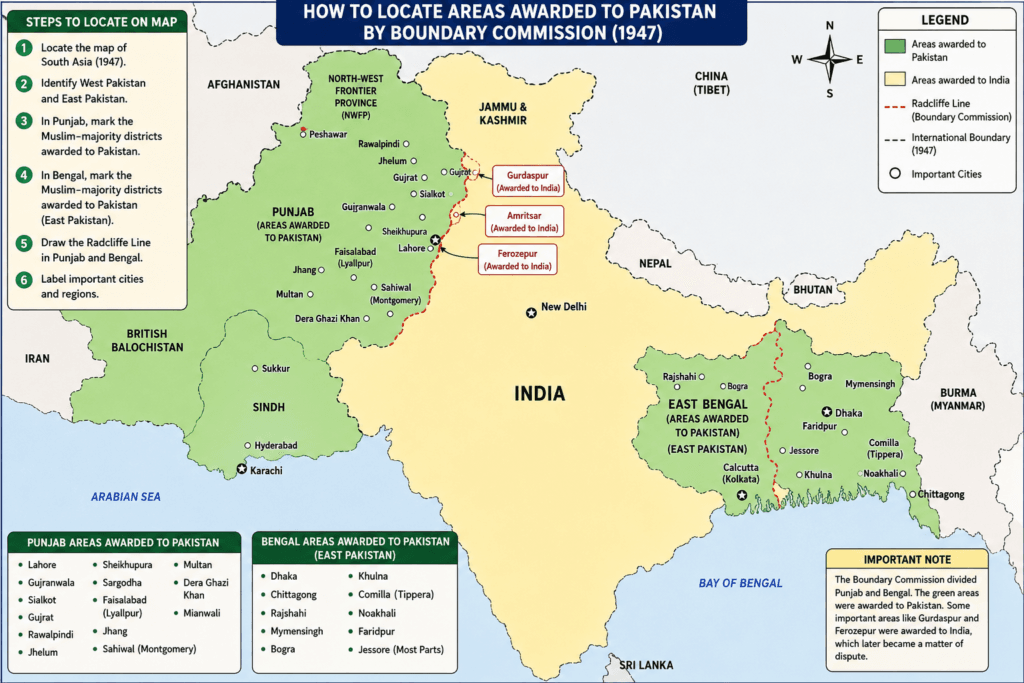
How to Locate These Areas on a Map
When studying a map of South Asia:
Step 1
Locate present-day Pakistan and Bangladesh.
Step 2
Identify Punjab in western Pakistan.
Mark:
- Lahore
- Faisalabad
- Rawalpindi
- Multan
- Sialkot
Step 3
Locate present-day Bangladesh (formerly East Pakistan).
Mark:
- Dhaka
- Chittagong
- Rajshahi
- Khulna
- Comilla
Step 4
Locate important border districts:
- Amritsar (India)
- Gurdaspur (India)
- Lahore (Pakistan)
These areas help explain the decisions of the Boundary Commission.
Significance of the Areas Awarded to Pakistan
Agricultural Importance
Punjab and East Bengal contained fertile agricultural land that supported Pakistan’s economy.
Strategic Importance
Cities such as Lahore, Rawalpindi, and Chittagong were strategically important for administration, defence, and trade.
Population
The awarded areas contained large Muslim-majority populations, which was the primary basis for partition.
Formation of Pakistan
These territories formed the geographical foundation of the new state of Pakistan.
Conclusion
The Boundary Commission awarded the western Muslim-majority districts of Punjab and the eastern Muslim-majority districts of Bengal to Pakistan. Important areas included Lahore, Rawalpindi, Faisalabad, Multan, Dhaka, Chittagong, Rajshahi, and Khulna. These territories became the core regions of Pakistan at independence in 1947. Understanding their location on the map of South Asia helps students understand how Pakistan was formed and why the Boundary Commission remains an important topic in the history of partition.
Quick Revision
Areas Awarded to Pakistan in Punjab
- Lahore
- Gujranwala
- Sialkot
- Gujrat
- Rawalpindi
- Jhelum
- Faisalabad (Lyallpur)
- Multan
- Sahiwal (Montgomery)
- Dera Ghazi Khan
Areas Awarded to Pakistan in Bengal
- Dhaka
- Chittagong
- Rajshahi
- Mymensingh
- Khulna
- Comilla
Areas Awarded to India
- Amritsar
- Gurdaspur (mostly)
- Ferozepur
Exam Question
Which major areas were awarded to Pakistan by the Boundary Commission in 1947?
The Boundary Commission awarded the western Muslim-majority districts of Punjab, including Lahore, Rawalpindi, Faisalabad, Multan, and Sialkot, and the eastern Muslim-majority districts of Bengal, including Dhaka, Chittagong, Rajshahi, and Khulna, to Pakistan. These regions formed the territorial basis of Pakistan at independence.
2.1.11 Construct a timeline to depict the political developments from
1940 to 1947 with reference to Pakistan Movement;
Timeline
1940 – Pakistan Resolution
23 March 1940
The All-India Muslim League held its annual session at Lahore.
Under the leadership of Muhammad Ali Jinnah, the League passed the Pakistan Resolution, which stated that Muslims were a separate nation and should have independent states in Muslim-majority areas.
Importance
- Marked the beginning of the demand for Pakistan.
- Provided a clear political goal for Muslims.
- Became the foundation of the Pakistan Movement.
1942 – Cripps Mission
March 1942
The British government sent Sir Stafford Cripps to India to seek support during World War II.
He proposed constitutional reforms and promised self-government after the war.
Importance
- Congress and the Muslim League rejected the proposals.
- Demonstrated that constitutional issues remained unresolved.
- Strengthened Muslim demands for separate political rights.
1944 – Gandhi-Jinnah Talks
September 1944
Mahatma Gandhi and Muhammad Ali Jinnah held discussions regarding India’s political future.
Importance
- Gandhi opposed partition.
- Jinnah insisted on the recognition of Muslims as a separate nation.
- Talks failed, increasing political differences between Congress and the Muslim League.
1945 – Simla Conference
June–July 1945
The British government invited Indian leaders to Simla to discuss constitutional arrangements.
Importance
- Muslim League demanded the right to nominate all Muslim representatives.
- Congress opposed this demand.
- Conference ended without agreement.
1945–46 – General Elections
The British government held elections for central and provincial legislatures.
Results
- Muslim League won about 90% of Muslim seats.
- Congress dominated non-Muslim constituencies.
Importance
- Demonstrated Muslim support for the Muslim League.
- Strengthened Jinnah’s claim that the League represented Indian Muslims.
- Increased support for Pakistan.
1946 – Cabinet Mission Plan
March 1946
A British delegation known as the Cabinet Mission arrived in India.
The mission proposed:
- A united India.
- A federal system.
- Provincial autonomy.
Importance
- Initially accepted by both parties.
- Later disagreements led to its failure.
- Increased support for partition.
16 August 1946 – Direct Action Day
The Muslim League announced Direct Action Day to demonstrate Muslim determination to achieve Pakistan.
Importance
- Showed Muslim commitment to the Pakistan demand.
- Increased pressure on Britain to find a solution.
- Highlighted the growing political divide.
1946 – Interim Government
An Interim Government was established under Congress leadership.
Importance
- Muslim League initially refused participation.
- Political tensions increased.
- Strengthened Muslim concerns about their future in a united India.
3 June 1947 – 3rd June Plan
British Prime Minister Clement Attlee’s government approved a partition plan.
Lord Mountbatten announced the plan on 3 June 1947.
Importance
- Accepted the partition of India.
- Provided the framework for the creation of Pakistan.
- Decided that power would be transferred quickly.
July 1947 – Indian Independence Act
The British Parliament passed the Indian Independence Act 1947.
Importance
- Legally created Pakistan and India.
- Ended British rule in the subcontinent.
- Determined the date of independence.
August 1947 – Boundary Commission Award
The Boundary Commission, headed by Sir Cyril Radcliffe, drew the borders between Pakistan and India.
Importance
- Divided Punjab and Bengal.
- Led to migration and refugee movements.
- Created disputes over certain territories.
14 August 1947 – Creation of Pakistan
Pakistan emerged as an independent state on 14 August 1947.
Muhammad Ali Jinnah became the first Governor-General of Pakistan.
Importance
- Fulfilled the demand of the Pakistan Movement.
- Marked the end of British colonial rule in Pakistan.
- Established a homeland for the Muslims of the subcontinent.
Conclusion
Between 1940 and 1947, a series of important political developments transformed the demand for Muslim rights into the creation of Pakistan. The Pakistan Resolution, constitutional negotiations, elections, Cabinet Mission Plan, 3rd June Plan, and Indian Independence Act all played significant roles in the success of the Pakistan Movement. These events ultimately led to the establishment of Pakistan on 14 August 1947, fulfilling the aspirations of millions of Muslims in the subcontinent.
Quick Revision Timeline
1940 → Pakistan Resolution
1942 → Cripps Mission
1944 → Gandhi-Jinnah Talks
1945 → Simla Conference
1945–46 → General Elections
1946 → Cabinet Mission Plan
1946 → Direct Action Day
1946 → Interim Government
1947 → 3rd June Plan
1947 → Indian Independence Act
1947 → Boundary Commission Award
14 August 1947 → Pakistan Created
2.2 Role of Political Leaders 2.2.1 discuss the role of following political leaders including
women and minorities in the making of Pakistan:
a. Quaid-e-Azam,
b. Allama Iqbal,
c. Fatima Jinnah,
d. Satya Prakash (SP) Singha.
Role of Political Leaders, Women, and Minorities in the Making of Pakistan
Introduction
The creation of Pakistan was the result of the efforts, sacrifices, and leadership of many individuals. Political leaders, women, students, journalists, and members of minority communities all contributed to the success of the Pakistan Movement.
Among the most important personalities were Quaid-e-Azam Muhammad Ali Jinnah, Allama Muhammad Iqbal, Mohtarma Fatima Jinnah, and Satya Prakash (S.P.) Singha. Their contributions helped shape Muslim political awareness, strengthen the demand for Pakistan, and support the establishment of the new state.
A. Quaid-e-Azam Muhammad Ali Jinnah (1876–1948)
Introduction
Muhammad Ali Jinnah was the founder of Pakistan and the most important leader of the Pakistan Movement. Because of his outstanding leadership and services, he is known as Quaid-e-Azam, meaning “Great Leader.”
He transformed the All-India Muslim League into a powerful political organization and successfully led the Muslims of the subcontinent towards the creation of Pakistan.
Early Political Career
Jinnah began his political career as a member of the Indian National Congress and later joined the All-India Muslim League.
Initially, he worked for Hindu-Muslim unity and constitutional reforms.
However, with time, he realized that Muslims needed separate political safeguards to protect their rights.
Leadership of the Muslim League
In the 1930s, Jinnah reorganized the Muslim League and united Muslims under a common political platform.
His Contributions Included:
- Strengthening the Muslim League.
- Creating political awareness among Muslims.
- Defending Muslim political rights.
- Negotiating with the British government and Congress.
Pakistan Resolution (1940)
One of Jinnah’s greatest achievements was leading the Muslim League during the Lahore Session of 1940.
The Pakistan Resolution demanded separate homelands for Muslims in Muslim-majority regions.
Jinnah became the principal spokesman of Muslim political aspirations.
Constitutional Struggle
Jinnah believed in constitutional and democratic methods.
He participated in important political negotiations, including:
- Round Table Conferences.
- Gandhi-Jinnah Talks.
- Simla Conference.
- Cabinet Mission discussions.
Elections of 1945–46
Under Jinnah’s leadership, the Muslim League achieved a remarkable victory in the elections.
The results demonstrated that the League represented the majority of Muslims in India.
Role in the Creation of Pakistan
Jinnah successfully negotiated with the British government and secured acceptance of the partition plan.
Pakistan was established on 14 August 1947, and Jinnah became its first Governor-General.
Importance
Father of the Nation
Jinnah is known as the Father of the Nation because of his decisive role in achieving Pakistan.
Political Leadership
He provided vision, unity, and direction to the Pakistan Movement.
Constitutional Struggle
He achieved Pakistan through political negotiations rather than armed conflict.
B. Allama Muhammad Iqbal (1877–1938)
Introduction
Allama Muhammad Iqbal was a philosopher, poet, thinker, and political leader. He is known as the Spiritual Father of Pakistan because he inspired the idea of a separate homeland for Muslims.
His poetry awakened political consciousness among Muslims and encouraged them to work for their future.
Educational and Intellectual Contributions
Iqbal was highly educated and studied in:
- Lahore
- Cambridge University
- Munich University
His writings focused on:
- Self-respect (Khudi)
- Muslim unity
- Revival of Islamic values
Allahabad Address (1930)
The most significant political contribution of Allama Iqbal was his Allahabad Address delivered in 1930.
In this address, he proposed:
The consolidation of Muslim-majority provinces in north-western India into a single political unit.
Although he did not specifically use the name Pakistan, many historians consider this speech an important step towards the creation of Pakistan.
Guidance to Jinnah
Iqbal maintained correspondence with Muhammad Ali Jinnah and encouraged him to lead the Muslims of India.
He believed that Muslim political rights could only be protected through strong leadership.
Contribution Through Poetry
Iqbal’s poetry inspired Muslims by promoting:
- Self-confidence.
- Unity.
- Education.
- Political awareness.
His ideas strengthened Muslim nationalism and political consciousness.
Importance
Visionary Thinker
Iqbal presented the intellectual foundation for a separate Muslim homeland.
Inspiration for Muslims
His poetry motivated Muslims to strive for political and social progress.
Influence on Pakistan Movement
His ideas greatly influenced the direction of Muslim politics.
C. Fatima Jinnah (1893–1967)
Introduction
Mohtarma Fatima Jinnah was the sister of Quaid-e-Azam Muhammad Ali Jinnah and one of the most prominent women leaders of the Pakistan Movement.
She is often called Madar-e-Millat (Mother of the Nation) because of her services to Pakistan.
Support for Quaid-e-Azam
Fatima Jinnah remained a close companion and supporter of her brother throughout the Pakistan Movement.
She assisted him during:
- Political meetings.
- Public gatherings.
- Election campaigns.
- National tours.
Mobilizing Women
One of her greatest contributions was encouraging women to participate in political activities.
She inspired women to:
- Attend public meetings.
- Support the Muslim League.
- Raise awareness about Pakistan.
- Contribute to social welfare activities.
Public Speaking and Political Awareness
Fatima Jinnah addressed public gatherings and motivated Muslims to support the Pakistan Movement.
Her speeches strengthened political awareness among women and families.
Role During the Elections of 1945–46
She actively campaigned for the Muslim League and encouraged women to support Muslim candidates.
This support contributed to the League’s electoral success.
Services After Independence
After the creation of Pakistan, Fatima Jinnah continued to work for:
- Social welfare.
- Women’s rights.
- Democratic values.
Importance
Symbol of Women’s Participation
She demonstrated that women could play an active role in national politics.
Support for Pakistan Movement
Her efforts expanded public support for Pakistan.
Madar-e-Millat
Her services earned her the title “Mother of the Nation.”
D. Satya Prakash (S.P.) Singha (1893–1948)
Introduction
Satya Prakash Singha, commonly known as S.P. Singha, was a Christian political leader from Punjab.
He belonged to the Christian minority community and supported the demand for Pakistan.
His role demonstrates that the Pakistan Movement was supported not only by Muslims but also by members of some minority communities.
Political Career
S.P. Singha was an influential political figure in Punjab.
He served in the Punjab Legislative Assembly and represented the interests of the Christian community.
Support for Pakistan
During the final years before partition, S.P. Singha supported the Muslim League’s position regarding the future of Punjab.
His support was important because political decisions in Punjab often depended on the votes of minority representatives.
Contribution in Punjab Assembly
In 1947, political discussions regarding Punjab’s future became extremely important.
S.P. Singha’s support helped strengthen the position of those favoring Pakistan.
His actions influenced political developments during a critical period of the Pakistan Movement.
Significance
Minority Support for Pakistan
His support showed that some minority communities believed their rights would be protected in Pakistan.
Political Importance
His role helped strengthen support for Pakistan in Punjab.
Symbol of Inclusion
He demonstrated that Pakistan’s creation involved contributions from people of different religious backgrounds.
Role of Women and Minorities in the Pakistan Movement
The Pakistan Movement was not limited to male political leaders.
Contributions of Women
Women:
- Organized meetings.
- Raised funds.
- Conducted awareness campaigns.
- Encouraged families to support the Muslim League.
Important women leaders included:
- Fatima Jinnah
- Begum Ra’ana Liaquat Ali Khan
- Begum Jahan Ara Shah Nawaz
Contributions of Minorities
Some members of minority communities also supported Pakistan.
Their participation demonstrated confidence in the vision of a state where different communities could live peacefully and enjoy equal rights.
Conclusion
The creation of Pakistan was the result of the efforts of many leaders and supporters. Quaid-e-Azam Muhammad Ali Jinnah provided political leadership and successfully guided the Pakistan Movement. Allama Muhammad Iqbal supplied the ideological vision that inspired Muslims to seek a separate homeland. Fatima Jinnah mobilized women and expanded public support for the movement, while S.P. Singha represented the contribution of minority communities to the cause of Pakistan. Together, these personalities played a significant role in the struggle that led to the establishment of Pakistan in 1947.
Quick Revision
| Leader | Contribution |
|---|---|
| Quaid-e-Azam Muhammad Ali Jinnah | Led the Pakistan Movement and founded Pakistan |
| Allama Muhammad Iqbal | Presented the vision of a separate Muslim homeland |
| Fatima Jinnah | Mobilized women and supported the Muslim League |
| S.P. Singha | Christian leader who supported Pakistan in Punjab politics |
Exam Question
Discuss the role of Quaid-e-Azam, Allama Iqbal, Fatima Jinnah, and S.P. Singha in the making of Pakistan.
Quaid-e-Azam Muhammad Ali Jinnah led the Pakistan Movement and secured the creation of Pakistan through constitutional struggle. Allama Iqbal provided the ideological foundation through his Allahabad Address and inspiring poetry. Fatima Jinnah mobilized women and supported the Muslim League’s political activities. S.P. Singha, a Christian leader from Punjab, supported Pakistan and demonstrated the contribution of minority communities to the Pakistan Movement.
Constitution of Pakistan
3.1 Objectives Resolution
SLO 3.1.1: Explain the Need and Importance of a Constitution for a State
Introduction
Every country needs a system of rules and principles to govern its affairs effectively. These rules help maintain order, protect the rights of citizens, and define how the government should function. This set of fundamental rules is known as a Constitution.
A constitution is considered the supreme law of a state because all institutions, laws, and government officials must operate according to it. Without a constitution, a country may face confusion, misuse of power, and political instability.
Pakistan, like other modern states, requires a constitution to ensure the smooth functioning of government and the protection of citizens’ rights.
What is a Constitution?
A constitution is a written or unwritten set of fundamental laws and principles that determines how a country is governed.
It explains:
- The structure of government.
- The powers and responsibilities of state institutions.
- The rights and duties of citizens.
- The relationship between the government and the people.
Because it is the highest law of the land, all other laws must be consistent with the constitution.
Why Does a State Need a Constitution?
A state needs a constitution to establish a clear system of government and provide guidelines for political, legal, and administrative activities.
Without a constitution:
- There would be no clear distribution of powers.
- Citizens’ rights might not be protected.
- Government institutions could misuse authority.
- Political disputes could increase.
Therefore, a constitution serves as the foundation of an organized and stable state.
Importance of a Constitution
1. Provides a Framework for Government
One of the most important functions of a constitution is to establish the structure of government.
It explains:
- How the government will be formed.
- Who will exercise authority.
- How decisions will be made.
For example, a constitution defines the roles of:
- The President
- The Prime Minister
- Parliament
- Courts
This prevents confusion and ensures that government institutions work within their assigned responsibilities.
2. Defines Powers and Responsibilities
A constitution clearly explains the powers and duties of different branches of government.
These branches usually include:
Legislature
Makes laws.
Executive
Implements and enforces laws.
Judiciary
Interprets laws and ensures justice.
By defining these powers, the constitution prevents one institution from becoming too powerful.
3. Protects Fundamental Rights
A constitution guarantees the basic rights and freedoms of citizens.
These rights may include:
- Equality before the law.
- Freedom of speech.
- Freedom of religion.
- Right to education.
- Protection of life and property.
Because these rights are protected by the constitution, citizens can seek legal protection if their rights are violated.
4. Maintains Rule of Law
The constitution ensures that everyone is subject to the law.
This principle is known as the Rule of Law.
Under the rule of law:
- No person is above the law.
- Government officials must obey the law.
- Citizens are treated equally before the law.
This helps create justice and fairness in society.
5. Prevents Misuse of Power
A constitution places limits on the powers of government officials.
Without constitutional limits, leaders might abuse their authority.
The constitution:
- Defines legal boundaries.
- Establishes checks and balances.
- Holds government officials accountable.
As a result, arbitrary rule and dictatorship can be prevented.
6. Promotes Political Stability
A constitution provides clear procedures for governing the country.
It explains:
- How leaders are elected.
- How governments are formed.
- How laws are made.
- How disputes are resolved.
These procedures reduce uncertainty and promote political stability.
7. Protects Democracy
In democratic countries, the constitution safeguards democratic principles.
It ensures:
- Free and fair elections.
- Public participation in government.
- Representation of citizens.
- Peaceful transfer of power.
Thus, the constitution strengthens democratic institutions.
8. Ensures Independence of the Judiciary
The constitution establishes an independent judiciary.
An independent judiciary:
- Interprets laws fairly.
- Protects citizens’ rights.
- Resolves disputes.
- Ensures justice.
This helps maintain public confidence in the legal system.
9. Promotes National Unity
A constitution provides a common legal framework for all citizens.
People from different:
- Provinces
- Languages
- Cultures
- Ethnic groups
are united under one constitutional system.
This promotes national integration and social harmony.
10. Guides Future Development
The constitution serves as a guide for future governance and development.
It provides principles for:
- Law-making.
- Economic policies.
- Social welfare.
- Education.
- National progress.
Governments use constitutional principles when planning for the country’s future.
Importance of a Constitution for Pakistan
After independence in 1947, Pakistan urgently needed a constitution because:
Establishing a New State
Pakistan was a newly created country and required a legal framework for governance.
Defining Government Structure
A constitution was needed to define the powers of:
- Federal government.
- Provincial governments.
- State institutions.
Protecting Citizens’ Rights
The people of Pakistan needed constitutional guarantees for their rights and freedoms.
Implementing National Ideals
The constitution would reflect the principles and objectives upon which Pakistan was founded.
Promoting Unity
Pakistan consisted of different regions and communities.
A constitution would help unite them under a common legal system.
Characteristics of a Good Constitution
A good constitution should:
Be Clear
Its provisions should be easy to understand.
Protect Rights
It should safeguard the rights of citizens.
Ensure Justice
It should promote fairness and equality.
Provide Stability
It should support effective governance.
Reflect National Values
It should represent the aspirations and beliefs of the people.
Consequences of Not Having a Constitution
A country without a constitution may face:
- Political instability.
- Conflicts over authority.
- Violation of rights.
- Weak governance.
- Misuse of power.
- Legal uncertainty.
Therefore, a constitution is essential for the smooth functioning of a state.
Conclusion
A constitution is the supreme law of a country and serves as the foundation of government and society. It defines the structure of government, distributes powers among institutions, protects citizens’ rights, maintains the rule of law, and promotes political stability. For Pakistan, a constitution was essential after independence to establish an effective system of governance and unite the nation under a common legal framework. The constitution continues to play a vital role in ensuring democracy, justice, and national development.
Key Terms
Constitution
The fundamental law that explains how a country is governed.
Rule of Law
The principle that everyone is subject to the law and no one is above it.
Legislature
The branch of government responsible for making laws.
Executive
The branch responsible for implementing laws.
Judiciary
The branch responsible for interpreting laws and administering justice.
Quick Revision
✓ A constitution is the supreme law of a state.
✓ It defines the structure and powers of government.
✓ It protects citizens’ rights and freedoms.
✓ It promotes the rule of law and democracy.
✓ It prevents misuse of power.
✓ It provides political stability and national unity.
✓ Pakistan needed a constitution to govern effectively after independence.
Exam Question
Why is a constitution important for a state?
A constitution is important because it provides a framework for government, defines the powers of state institutions, protects citizens’ rights, maintains the rule of law, prevents misuse of power, promotes political stability, and ensures effective governance. It serves as the supreme law of the state and guides the country’s political and legal system.
Constitution of Pakistan
3.1 Objectives Resolution
SLO 3.1.2: Discuss the Reasons for the Delay in Making the First Constitution of Pakistan
Introduction
When Pakistan emerged as an independent state on 14 August 1947, one of the most important tasks facing the new country was the preparation of a constitution. A constitution was needed to establish a system of government, define the powers of state institutions, and protect the rights of citizens.
The responsibility for preparing the constitution was given to the Constituent Assembly of Pakistan. However, despite continuous efforts, Pakistan’s first constitution was not enforced until 23 March 1956. As a result, Pakistan remained without a permanent constitution for nearly nine years and continued to function under the Government of India Act 1935, with certain modifications.
The delay occurred because Pakistan faced numerous political, constitutional, administrative, and economic challenges during its early years.
What Was the Constituent Assembly?
The Constituent Assembly was the body responsible for:
- Making laws for the country.
- Preparing and approving the constitution.
Soon after independence, the Assembly began discussions on constitutional issues. In March 1949, it passed the Objectives Resolution, which laid down the guiding principles for the future constitution. On the same day, a Basic Principles Committee (BPC) was established to prepare constitutional recommendations.
Although these steps were important, many disagreements and challenges delayed the completion of the constitution.
3.1.2 Reasons for the Delay in Making the First Constitution
Reasons for the Delay in Making the First Constitution
1. Disagreement Between East and West Pakistan
The most significant reason for the delay was the disagreement between East Pakistan and West Pakistan regarding political representation.
At the time of independence, East Pakistan had a larger population than West Pakistan. Therefore, leaders from East Pakistan argued that representation in the national legislature should be based on population. They believed that democratic principles required the majority population to have more representatives.
However, leaders from West Pakistan feared that East Pakistan would dominate national politics if representation were based solely on population. They demanded equal representation for both wings of the country.
This disagreement created a constitutional deadlock because both sides wanted arrangements that would protect their political interests.
2. Dispute Over Provincial Autonomy
Another major issue concerned the distribution of powers between the federal government and the provinces.
East Pakistan’s Position
Leaders from East Pakistan favored greater provincial autonomy. They wanted provincial governments to have more authority over their own affairs.
West Pakistan’s Position
Many leaders in West Pakistan supported a strong central government. They believed that a powerful centre was necessary to maintain national unity and ensure effective administration.
As a result, there was no agreement on how powers should be divided between the centre and the provinces. This issue delayed the drafting of constitutional provisions.
3. Debate on the Islamic Nature of the Constitution
Pakistan was created in the name of Islam, but there were different opinions regarding how Islamic principles should be incorporated into the constitution.
Some leaders believed that:
- Islamic teachings should form the basis of the constitution.
- Laws should be consistent with the Holy Quran and Sunnah.
Others emphasized:
- Democratic governance.
- Protection of minority rights.
- Modern constitutional principles.
Although the Objectives Resolution of 1949 declared that sovereignty belongs to Allah and that Muslims would be enabled to live according to Islamic teachings, discussions continued regarding the exact role of Islam in the constitutional framework.
These debates required considerable time and delayed progress.
4. Opposition to the Basic Principles Committee Reports
The Basic Principles Committee (BPC) was established in 1949 to prepare recommendations for the future constitution.
The committee submitted its reports, but they faced strong criticism from various groups.
Criticism from East Pakistan
Many leaders argued that the proposals did not adequately recognize East Pakistan’s larger population.
Criticism from Religious Scholars
Some religious leaders felt that the recommendations did not sufficiently reflect Islamic principles.
Political Objections
Several political parties disagreed with the proposed distribution of powers and representation.
Because of these objections, the committee had to revise its recommendations repeatedly, which slowed the constitution-making process.
5. Language Controversy
The issue of the national language became another source of disagreement.
Supporters of Urdu
Many leaders considered Urdu a symbol of Muslim identity and wanted it to be the sole national language.
Supporters of Bengali
Leaders from East Pakistan demanded equal recognition for Bengali because it was spoken by the majority of Pakistan’s population.
The language controversy created political tensions and made it more difficult to achieve consensus on constitutional matters.
6. Death of Quaid-e-Azam Muhammad Ali Jinnah
Quaid-e-Azam Muhammad Ali Jinnah passed away on 11 September 1948, only thirteen months after independence.
His death was a major setback for the country.
As the founder of Pakistan and its most respected leader, Jinnah had the ability to unite different political groups and guide constitutional discussions. His absence created a leadership vacuum and slowed the constitution-making process.
7. Assassination of Liaquat Ali Khan
Prime Minister Liaquat Ali Khan played a vital role in constitutional development.
He:
- Introduced the Objectives Resolution.
- Supported the work of the Constituent Assembly.
- Led efforts to frame the constitution.
However, he was assassinated on 16 October 1951.
His death created political uncertainty and deprived the country of another important leader. As a result, constitutional progress slowed further.
8. Refugee Crisis and Administrative Problems
At independence, Pakistan faced serious administrative and economic challenges.
Millions of Muslim refugees migrated from India to Pakistan and required:
- Housing
- Employment
- Food
- Healthcare
At the same time, Pakistan had to:
- Establish government departments.
- Build administrative institutions.
- Manage limited financial resources.
The government had to focus on these urgent issues, leaving less time and attention for constitutional matters.
9. Security Challenges and the Kashmir Issue
Soon after independence, Pakistan became involved in disputes with India, particularly over Kashmir.
The government had to deal with:
- Border problems.
- Defence concerns.
- Refugee movements.
- Foreign policy issues.
These challenges demanded immediate attention and contributed to delays in constitution making.
10. Frequent Political Changes
Pakistan experienced political instability during its early years.
Changes in leadership, disagreements among politicians, and conflicts between institutions slowed decision-making.
Instead of focusing entirely on constitutional development, political leaders often became involved in power struggles and administrative disputes.
11. Dissolution of the First Constituent Assembly (1954)
The most serious obstacle occurred on 24 October 1954, when Governor-General Ghulam Muhammad dissolved the First Constituent Assembly.
This happened at a time when the Assembly was close to completing its constitutional work.
The dissolution:
- Interrupted the constitution-making process.
- Created a constitutional crisis.
- Forced the establishment of a new Constituent Assembly.
As a result, several additional years were required before the constitution could be finalized.
12. Formation of the Second Constituent Assembly
A new Constituent Assembly was formed in 1955.
The Second Constituent Assembly worked to resolve earlier disputes and introduced important measures such as:
One Unit Scheme
The provinces of West Pakistan were merged into one administrative unit.
Parity Formula
Equal representation was provided to East Pakistan and West Pakistan in the central legislature.
These compromises helped overcome earlier disagreements and enabled the completion of the constitution.
Adoption of the First Constitution
After years of discussion and debate:
- The Constitution was passed on 29 February 1956.
- It was authenticated on 2 March 1956.
- It came into force on 23 March 1956.
With the enforcement of the Constitution of 1956, Pakistan officially became the Islamic Republic of Pakistan.
Conclusion
The delay in making Pakistan’s first constitution was caused by a combination of political, constitutional, and administrative challenges. Disagreements between East and West Pakistan, debates over provincial autonomy and Islamic provisions, the language controversy, criticism of the Basic Principles Committee reports, political instability, the deaths of Quaid-e-Azam and Liaquat Ali Khan, refugee and security problems, and the dissolution of the First Constituent Assembly all contributed to the delay. Despite these difficulties, Pakistan successfully adopted its first constitution on 23 March 1956, nearly nine years after independence.
Key Terms
Constituent Assembly
The body responsible for making laws and framing the constitution of Pakistan.
Objectives Resolution (1949)
A resolution that laid down the guiding principles for Pakistan’s future constitution.
Basic Principles Committee
A committee formed to prepare recommendations for the constitution.
Provincial Autonomy
The right of provinces to manage their own affairs with limited interference from the federal government.
One Unit Scheme
A plan introduced in 1955 that merged the provinces of West Pakistan into a single administrative unit.
Quick Revision
| Reason for Delay | Explanation |
|---|---|
| East-West Pakistan dispute | Disagreement over representation |
| Provincial autonomy issue | Conflict over division of powers |
| Islamic provisions debate | Different views on the role of Islam |
| Opposition to BPC reports | Constitutional proposals required revisions |
| Language controversy | Urdu and Bengali issue |
| Death of Quaid-e-Azam | Loss of national leadership |
| Assassination of Liaquat Ali Khan | Political instability |
| Refugee and administrative problems | Immediate post-independence challenges |
| Kashmir and security issues | Government focused on national defence |
| Dissolution of Constituent Assembly | Constitution-making process interrupted |
| Formation of Second Assembly | Additional time required to complete constitution |
Exam Question
Discuss the major reasons for the delay in making Pakistan’s first constitution.
Pakistan’s first constitution was delayed because of disagreements between East and West Pakistan regarding representation and provincial autonomy, debates about Islamic provisions, language disputes, criticism of the Basic Principles Committee reports, political instability caused by the deaths of Quaid-e-Azam and Liaquat Ali Khan, refugee and administrative problems, security challenges, and the dissolution of the First Constituent Assembly in 1954. These issues delayed the constitution until it was finally implemented on 23 March 1956.
3.1.3 Discuss the salient features of the Objectives Resolution 1949
Introduction
After the creation of Pakistan in 1947, one of the most important responsibilities of the Constituent Assembly was to frame a constitution for the new state. To provide guidance for constitution making, the Objectives Resolution was presented by Prime Minister Liaquat Ali Khan in the Constituent Assembly on 7 March 1949 and was passed on 12 March 1949.
The Objectives Resolution laid down the fundamental principles that would guide the future constitution of Pakistan. It reflected the aspirations of the people of Pakistan and attempted to combine Islamic principles with democratic values.
Because of its importance, the Objectives Resolution is often described as the foundation of Pakistan’s constitutional development.
What is the Objectives Resolution?
The Objectives Resolution was a constitutional document that outlined the basic principles upon which Pakistan’s future constitution would be based.
It served as:
- A guiding framework for constitution making.
- A statement of national ideals.
- A declaration of the political and constitutional objectives of Pakistan.
The Resolution later became an important part of Pakistan’s constitutional history and was incorporated into subsequent constitutions.
Background of the Objectives Resolution
After independence, there was considerable debate about the nature of the future constitution.
Important questions included:
- What would be the role of Islam in the state?
- How would democracy function in Pakistan?
- How would the rights of citizens be protected?
- What powers would government institutions have?
To address these questions, Prime Minister Liaquat Ali Khan introduced the Objectives Resolution in the Constituent Assembly.
The Resolution provided a clear direction for the constitutional future of Pakistan.
Salient Features of the Objectives Resolution 1949
1. Sovereignty Belongs to Allah
The most important feature of the Objectives Resolution was the declaration that:
Sovereignty over the entire universe belongs to Almighty Allah alone.
The Resolution stated that the authority exercised by the people of Pakistan would be a sacred trust granted by Allah.
Importance
- Recognized the Islamic foundation of the state.
- Affirmed that all authority should be exercised within the limits prescribed by Islam.
- Distinguished Pakistan from a purely secular state.
2. Authority Through the Chosen Representatives of the People
Although sovereignty belongs to Allah, the Resolution declared that the people would exercise authority through their elected representatives.
Importance
- Supported democratic government.
- Recognized the role of elections.
- Ensured public participation in governance.
This principle combined Islamic teachings with democratic values.
3. Democracy, Freedom, Equality, Tolerance, and Social Justice
The Resolution emphasized that the principles of:
- Democracy
- Freedom
- Equality
- Tolerance
- Social Justice
would be observed in Pakistan according to Islamic teachings.
Importance
- Promoted a democratic political system.
- Encouraged fairness and equality.
- Supported peaceful coexistence among citizens.
4. Muslims Would Be Enabled to Live According to Islam
The Resolution stated that Muslims would be provided opportunities to:
- Organize their lives according to the Holy Quran and Sunnah.
- Practice Islamic teachings.
- Develop their individual and collective lives in accordance with Islam.
Importance
- Reflected the aspirations of Muslims who supported the creation of Pakistan.
- Strengthened the Islamic identity of the state.
5. Protection of Minority Rights
The Objectives Resolution recognized the rights of non-Muslim citizens.
It guaranteed that minorities would be free to:
- Practice their religions.
- Develop their cultures.
- Enjoy their religious freedoms.
Importance
- Promoted religious tolerance.
- Protected minority communities.
- Demonstrated Pakistan’s commitment to equal citizenship.
6. Federal System of Government
The Resolution stated that Pakistan would be organized as a federation.
Importance
- Recognized the existence of provinces.
- Allowed provincial participation in governance.
- Promoted national unity while respecting regional diversity.
This principle later influenced the federal structure of Pakistan’s constitutions.
7. Independence of the Judiciary
The Resolution emphasized that the judiciary would be independent.
Importance
- Ensured fair administration of justice.
- Protected citizens against misuse of power.
- Strengthened the rule of law.
An independent judiciary became an important feature of Pakistan’s constitutional system.
8. Fundamental Rights of Citizens
The Resolution promised that citizens would enjoy fundamental rights.
These included:
- Equality before the law.
- Freedom of thought.
- Freedom of expression.
- Freedom of belief.
- Freedom of association.
Importance
- Protected individual liberties.
- Promoted democratic values.
- Limited arbitrary government action.
9. Protection of Social and Economic Justice
The Resolution aimed to establish a society based on justice and fairness.
It emphasized:
- Social welfare.
- Economic justice.
- Equal opportunities.
Importance
- Encouraged the welfare of citizens.
- Promoted balanced development.
- Supported the reduction of inequalities.
10. Contribution to World Peace
The Objectives Resolution stated that Pakistan would contribute to:
- International peace.
- Human progress.
- Cooperation among nations.
Importance
- Reflected Pakistan’s commitment to peaceful international relations.
- Encouraged constructive engagement with the global community.
Why Was the Objectives Resolution Important?
The Objectives Resolution was important because it:
Provided Constitutional Guidance
It established the principles that guided constitution making in Pakistan.
Combined Islam and Democracy
It attempted to harmonize Islamic teachings with democratic governance.
Defined National Ideals
It expressed the aspirations and goals of the people of Pakistan.
Influenced Future Constitutions
The Constitutions of:
- 1956
- 1962
- 1973
all reflected the principles of the Objectives Resolution.
Became a Constitutional Part of Pakistan
Under later constitutional developments, the Objectives Resolution became a substantive part of the Constitution of Pakistan.
Criticism of the Objectives Resolution
Although widely supported, some minority representatives expressed concerns.
They feared that:
- The Resolution might give religion a greater role in politics.
- Minority interests might not receive equal attention.
However, supporters argued that the Resolution clearly guaranteed minority rights and religious freedom.
Historical Significance
The Objectives Resolution occupies a special place in Pakistan’s constitutional history because it:
- Served as the constitutional foundation of the state.
- Defined the ideological direction of Pakistan.
- Influenced all future constitutional developments.
- Linked Islamic values with democratic governance.
For this reason, it is often called the constitutional cornerstone of Pakistan.
Conclusion
The Objectives Resolution of 1949 was a landmark document in Pakistan’s constitutional history. It declared that sovereignty belongs to Allah, supported democratic governance through elected representatives, guaranteed fundamental rights, protected minority freedoms, promoted social justice, and emphasized the independence of the judiciary. The Resolution provided the foundation for Pakistan’s future constitutions and continues to hold great constitutional and historical significance.
Key Terms
Objectives Resolution
A constitutional resolution passed on 12 March 1949 that provided the guiding principles for Pakistan’s future constitution.
Sovereignty
Supreme authority or power to govern.
Federal System
A system in which powers are divided between the central government and provincial governments.
Fundamental Rights
Basic rights and freedoms guaranteed to citizens.
Judiciary
The branch of government responsible for interpreting laws and administering justice.
Quick Revision
| Salient Feature | Explanation |
|---|---|
| Sovereignty of Allah | Ultimate authority belongs to Allah |
| Elected Representatives | People exercise authority through elected representatives |
| Democracy and Equality | Democratic principles based on Islam |
| Islamic Way of Life | Muslims enabled to live according to Quran and Sunnah |
| Minority Rights | Religious freedom for minorities |
| Federal System | Pakistan to function as a federation |
| Independent Judiciary | Fair administration of justice |
| Fundamental Rights | Protection of citizens’ freedoms |
| Social and Economic Justice | Welfare and equality for all citizens |
| International Peace | Cooperation and peace among nations |
3.1.4 Explain the significance of the Objectives Resolution 1949
Introduction
The Objectives Resolution of 1949 is one of the most important documents in the constitutional history of Pakistan. It was presented by Prime Minister Liaquat Ali Khan in the Constituent Assembly and passed on 12 March 1949.
The Resolution provided the guiding principles for the future constitution of Pakistan. It outlined the political, democratic, social, and Islamic ideals upon which the state would be built. For this reason, the Objectives Resolution is often regarded as the foundation stone of Pakistan’s constitutional development.
Its significance lies not only in the principles it introduced but also in its long-lasting influence on all subsequent constitutions of Pakistan.
What Does Significance Mean?
The significance of an event or document refers to its importance, impact, and influence.
The Objectives Resolution is significant because it:
- Defined the constitutional direction of Pakistan.
- Guided the framing of future constitutions.
- Reflected the aspirations of the people of Pakistan.
- Combined Islamic principles with democratic values.
Significance of the Objectives Resolution 1949
1. Foundation of Pakistan’s Constitutional Development
The Objectives Resolution served as the first major constitutional document adopted after independence.
Before a constitution could be written, it was necessary to determine the basic principles on which the state would be governed.
The Resolution provided this framework and became the basis for constitution making.
Importance
- Laid the foundation of Pakistan’s constitutional system.
- Guided future constitutional discussions.
- Provided a clear direction for lawmakers.
Because of this role, it is often called the constitutional foundation of Pakistan.
2. Defined the Ideology of Pakistan
One of the most important contributions of the Objectives Resolution was that it clarified the ideological basis of the state.
It declared that:
Sovereignty over the entire universe belongs to Almighty Allah.
At the same time, it recognized that authority would be exercised through the elected representatives of the people.
Importance
- Reflected the Islamic identity of Pakistan.
- Linked governance with Islamic principles.
- Defined the ideological character of the state.
This helped explain how Pakistan would combine Islamic values with modern democratic institutions.
3. Combined Islam and Democracy
The Resolution demonstrated that Islamic principles and democratic governance could work together.
It emphasized:
- Democracy
- Freedom
- Equality
- Tolerance
- Social justice
within the framework of Islam.
Importance
- Established democratic principles in Pakistan.
- Encouraged public participation through elected representatives.
- Promoted accountability in government.
This balance between Islam and democracy became a defining feature of Pakistan’s constitutional development.
4. Guided the Framing of Future Constitutions
The Objectives Resolution became the guiding document for all future constitutions.
Its principles influenced:
Constitution of 1956
Pakistan’s first constitution incorporated the ideals of the Objectives Resolution.
Constitution of 1962
Many constitutional principles continued to reflect the Resolution.
Constitution of 1973
The Objectives Resolution was fully incorporated into Pakistan’s constitutional framework.
Importance
- Ensured continuity in constitutional development.
- Influenced constitutional thinking for decades.
5. Guaranteed Fundamental Rights
The Resolution promised that citizens would enjoy fundamental rights and freedoms.
These included:
- Equality before law.
- Freedom of belief.
- Freedom of expression.
- Freedom of association.
Importance
- Protected individual liberties.
- Promoted democratic governance.
- Limited arbitrary use of power.
This commitment helped establish a constitutional culture based on rights and responsibilities.
6. Protected Minority Rights
The Objectives Resolution guaranteed that non-Muslim citizens would have the freedom to:
- Practice their religions.
- Preserve their cultures.
- Develop their communities.
Importance
- Demonstrated respect for religious diversity.
- Promoted tolerance and coexistence.
- Reassured minority communities about their rights.
This principle remains an important part of Pakistan’s constitutional philosophy.
7. Strengthened the Concept of Rule of Law
The Resolution emphasized justice, equality, and constitutional governance.
It supported the idea that:
- Government authority should operate within legal limits.
- Citizens should be treated fairly.
- Laws should be applied equally.
Importance
- Promoted accountability.
- Prevented misuse of power.
- Strengthened constitutional government.
8. Promoted Social and Economic Justice
The Resolution aimed to establish a society based on fairness and welfare.
It encouraged:
- Equal opportunities.
- Social welfare.
- Economic justice.
Importance
- Reflected the state’s responsibility towards its citizens.
- Promoted balanced development.
- Supported the welfare of disadvantaged groups.
9. Ensured Independence of the Judiciary
The Objectives Resolution emphasized the establishment of an independent judiciary.
Importance
An independent judiciary:
- Protects citizens’ rights.
- Interprets laws fairly.
- Resolves disputes impartially.
- Upholds the constitution.
This principle became an essential feature of Pakistan’s constitutional structure.
10. Became a Permanent Part of the Constitution
The significance of the Objectives Resolution increased over time.
In 1985, through constitutional amendments, it became a substantive part of the Constitution of Pakistan.
Importance
- Gained constitutional status.
- Became legally significant.
- Continued to guide constitutional interpretation.
As a result, the Resolution remains relevant even today.
Long-Term Impact of the Objectives Resolution
The Objectives Resolution has influenced Pakistan’s political and constitutional development in many ways.
Constitutional Impact
Provided a framework for future constitutions.
Political Impact
Defined the relationship between Islam and democracy.
Social Impact
Promoted justice, equality, and welfare.
Legal Impact
Strengthened constitutional and judicial principles.
Because of these impacts, it remains one of the most influential documents in Pakistan’s history.
Why Is It Called the Foundation of the Constitution?
The Objectives Resolution is often called the foundation of Pakistan’s constitution because:
- It was the first constitutional guideline adopted after independence.
- It defined the principles on which future constitutions were based.
- It shaped constitutional debates for many years.
- Its provisions were incorporated into later constitutions.
Without the Objectives Resolution, constitution makers would not have had a clear framework to guide their work.
Conclusion
The Objectives Resolution of 1949 holds immense significance in Pakistan’s constitutional history. It provided the ideological and constitutional foundation of the state by combining Islamic principles with democratic values. It guided the framing of future constitutions, guaranteed fundamental rights, protected minority freedoms, promoted social justice, strengthened the rule of law, and emphasized judicial independence. Because of its lasting influence on Pakistan’s constitutional system, it is regarded as one of the most important documents in the country’s history.
Key Terms
Objectives Resolution
A constitutional resolution passed on 12 March 1949 that provided guiding principles for Pakistan’s future constitution.
Constitutional Development
The process of creating and improving a country’s constitutional system.
Rule of Law
The principle that everyone is subject to the law and no one is above it.
Fundamental Rights
Basic rights and freedoms guaranteed to citizens.
Judiciary
The branch of government responsible for interpreting laws and ensuring justice.
Quick Revision
| Significance | Explanation |
|---|---|
| Constitutional Foundation | Guided the making of Pakistan’s constitutions |
| Defined Ideology | Clarified the Islamic identity of Pakistan |
| Combined Islam and Democracy | Linked Islamic principles with democratic governance |
| Guided Future Constitutions | Influenced the 1956, 1962, and 1973 Constitutions |
| Guaranteed Rights | Protected fundamental freedoms |
| Protected Minorities | Ensured religious freedom for non-Muslims |
| Promoted Rule of Law | Encouraged constitutional government |
| Social Justice | Supported welfare and equality |
| Judicial Independence | Strengthened the judiciary |
| Constitutional Status | Became part of the Constitution of Pakistan |
Exam Question
Explain the significance of the Objectives Resolution 1949.
The Objectives Resolution is significant because it provided the constitutional and ideological foundation of Pakistan. It combined Islamic principles with democratic values, guided the framing of future constitutions, guaranteed fundamental rights, protected minority freedoms, promoted social justice, strengthened the rule of law, ensured judicial independence, and became an important part of Pakistan’s constitutional framework. It continues to influence Pakistan’s constitutional and political system today.
3.2 Salient Features of 1956, 1962, 1973Constitutions
3.2.1 describe the salient features of the 1956, 1962 and 1973 Constitutions;
Introduction
Since independence, Pakistan has had three permanent constitutions:
- Constitution of 1956
- Constitution of 1962
- Constitution of 1973
Each constitution was introduced under different political circumstances and reflected the needs and priorities of its time. While all three constitutions aimed to provide a framework for governing Pakistan, they differed in their systems of government, distribution of powers, and constitutional features.
The 1956 Constitution established a parliamentary system, the 1962 Constitution introduced a presidential system, and the 1973 Constitution restored parliamentary democracy and remains the Constitution of Pakistan today.
Constitution of 1956
Background
After nearly nine years of constitutional discussions and debates, Pakistan’s first constitution was adopted on 23 March 1956.
It ended the interim constitutional arrangement under the Government of India Act 1935 and officially transformed Pakistan into a constitutional state.
Salient Features of the 1956 Constitution
1. Islamic Republic of Pakistan
The constitution declared Pakistan as the:
“Islamic Republic of Pakistan”
This reflected the Islamic identity of the state.
Importance
- First time Pakistan was officially called an Islamic Republic.
- Reflected the aspirations of the Muslim population.
2. Parliamentary System
The 1956 Constitution established a parliamentary form of government.
Features
- Prime Minister was the head of government.
- President was the ceremonial head of state.
- The Cabinet was responsible to Parliament.
Importance
- Encouraged representative government.
- Limited the powers of the President.
3. Federal System
Pakistan was established as a federation.
Features
- Powers were divided between the federal and provincial governments.
- Provinces were given constitutional status.
Importance
- Promoted participation of provinces in governance.
4. Unicameral Legislature
The constitution created a one-house Parliament called the National Assembly.
Importance
- Simplified the legislative process.
- Ensured representation of both East and West Pakistan.
5. Principle of Parity
Although East Pakistan had a larger population, both East and West Pakistan were given equal representation in the National Assembly.
Importance
- Aimed to maintain balance between the two wings.
6. Fundamental Rights
The constitution guaranteed:
- Freedom of speech.
- Freedom of religion.
- Equality before law.
- Protection of property.
Importance
- Protected citizens’ rights and liberties.
7. Independent Judiciary
The judiciary was made independent of the executive.
Importance
- Ensured fair administration of justice.
- Protected constitutional rights.
8. Islamic Provisions
The constitution stated that:
- No law would be made against the Quran and Sunnah.
- Muslims would be enabled to live according to Islamic teachings.
Importance
- Reflected the principles of the Objectives Resolution.
Constitution of 1962
Background
In October 1958, the 1956 Constitution was abrogated following the imposition of Martial Law.
President Field Marshal Muhammad Ayub Khan introduced a new constitution on 8 June 1962.
Salient Features of the 1962 Constitution
1. Presidential System
The most important feature was the introduction of a presidential system.
Features
- President became both Head of State and Head of Government.
- Prime Minister’s office was abolished.
Importance
- Concentrated executive authority in the President.
2. Strong Central Government
The constitution gave extensive powers to the federal government.
Importance
- Strengthened central authority.
- Reduced provincial influence.
3. Basic Democracies System
The President was elected indirectly through representatives known as Basic Democrats.
Features
- About 80,000 Basic Democrats formed the electoral college.
- Citizens did not directly elect the President.
Importance
- Introduced local government participation in elections.
4. Unicameral Legislature
The National Assembly remained a one-house legislature.
Importance
- Continued the unicameral structure.
5. Fundamental Rights
Initially, fundamental rights were not included but were later added through constitutional amendments.
Importance
- Strengthened protection of citizens’ freedoms.
6. Islamic Provisions
The Objectives Resolution was included in the preamble.
An advisory body was created to recommend laws consistent with Islam.
Importance
- Maintained the Islamic character of the state.
7. Independent Judiciary
The constitution provided for an independent judiciary and established the Supreme Court.
Importance
- Continued constitutional protection of justice.
8. National Language
Urdu and Bengali were recognized as national languages.
Importance
- Acknowledged the linguistic reality of both wings of Pakistan.
Constitution of 1973
Background
After the separation of East Pakistan in 1971, a new constitution became necessary.
Under the leadership of Zulfikar Ali Bhutto, a consensus constitution was adopted on 14 August 1973.
It remains Pakistan’s current constitution.
Salient Features of the 1973 Constitution
1. Parliamentary System
The 1973 Constitution restored the parliamentary form of government.
Features
- Prime Minister became the head of government.
- President became the constitutional head of state.
- Cabinet responsible to Parliament.
Importance
- Strengthened democratic governance.
2. Federal System
Pakistan was established as a federation consisting of provinces.
Features
- Powers divided between federal and provincial governments.
- Greater provincial participation.
Importance
- Promoted national unity and provincial autonomy.
3. Bicameral Legislature
The constitution introduced a two-house Parliament.
National Assembly
Represents the population.
Senate
Provides equal provincial representation.
Importance
- Improved representation.
- Protected provincial interests.
4. Islamic Republic of Pakistan
Pakistan continued to be known as the Islamic Republic of Pakistan.
Importance
- Maintained the Islamic identity of the state.
5. Islam as State Religion
The constitution declared Islam as the state religion.
Importance
- Strengthened the Islamic character of the constitution.
6. Fundamental Rights
The constitution guarantees extensive fundamental rights, including:
- Freedom of speech.
- Freedom of religion.
- Equality before law.
- Right to education.
- Protection against discrimination.
Importance
- Protects citizens’ liberties.
7. Independence of Judiciary
The judiciary was made independent.
Importance
- Ensures justice and constitutional supremacy.
8. Council of Islamic Ideology
A constitutional body was established to advise whether laws conform to Islamic teachings.
Importance
- Promotes harmony between legislation and Islam.
9. Provincial Autonomy
The constitution provides significant powers to provinces.
Importance
- Addresses regional concerns.
- Strengthens the federal system.
10. Constitutional Supremacy
The constitution is the supreme law of Pakistan.
Importance
- All institutions must function within constitutional limits.
Comparison of the Three Constitutions
| Feature | 1956 Constitution | 1962 Constitution | 1973 Constitution |
|---|---|---|---|
| Year Enforced | 1956 | 1962 | 1973 |
| Type of Government | Parliamentary | Presidential | Parliamentary |
| Head of Government | Prime Minister | President | Prime Minister |
| Head of State | President | President | President |
| Legislature | Unicameral | Unicameral | Bicameral |
| Federal System | Yes | Yes | Yes |
| Islamic Republic | Yes | Initially Republic of Pakistan, later Islamic Republic | Yes |
| Fundamental Rights | Yes | Added later | Yes |
| Judiciary | Independent | Independent | Independent |
| Status Today | Repealed | Repealed | Current Constitution |
Conclusion
The Constitutions of 1956, 1962, and 1973 played important roles in Pakistan’s constitutional development. The 1956 Constitution established Pakistan’s first parliamentary democracy and declared the country an Islamic Republic. The 1962 Constitution introduced a presidential system and strengthened the powers of the President. The 1973 Constitution restored parliamentary democracy, introduced a bicameral legislature, strengthened provincial participation, and remains the supreme law of Pakistan today. Together, these constitutions reflect Pakistan’s constitutional evolution and efforts to establish an effective system of governance.
Quick Revision
1956 Constitution
✓ First Constitution
✓ Parliamentary System
✓ Islamic Republic
✓ Unicameral Legislature
✓ Parity between East and West Pakistan
1962 Constitution
✓ Presidential System
✓ Basic Democracies
✓ Strong President
✓ Unicameral Legislature
✓ Urdu and Bengali National Languages
1973 Constitution
✓ Parliamentary System
✓ Bicameral Parliament
✓ Islam as State Religion
✓ Provincial Autonomy
✓ Current Constitution of Pakistan
3.2 Salient Features of the 1956, 1962, and 1973 Constitutions
SLO 3.2.2: Compare the Constitutions of 1956 and 1962 with Reference to the Islamic Features, Form of Government, Executive Powers, Supreme Judicial Council, List of Subjects, and Fundamental Rights
Introduction
The Constitution of 1956 and the Constitution of 1962 were the first two constitutions of Pakistan. Both constitutions aimed to provide a framework for governing the country, but they differed significantly in several areas.
The 1956 Constitution was based on a parliamentary system, while the 1962 Constitution introduced a presidential system. Similarly, there were important differences regarding Islamic provisions, executive authority, legislative powers, the judiciary, and fundamental rights.
Studying these differences helps us understand how Pakistan’s constitutional system evolved during its early years.
Historical Background
Constitution of 1956
- Enforced on 23 March 1956.
- Pakistan became the Islamic Republic of Pakistan.
- Established a parliamentary form of government.
- Remained in force until October 1958.
Constitution of 1962
- Enforced on 8 June 1962.
- Introduced by President Field Marshal Muhammad Ayub Khan.
- Established a presidential system.
- Remained in force until 1969.
Comparison Between the Constitutions of 1956 and 1962
1. Islamic Features
Constitution of 1956
The 1956 Constitution gave considerable importance to Islamic principles.
Its Islamic features included:
- Pakistan was declared the Islamic Republic of Pakistan.
- No law could be made against the Quran and Sunnah.
- Muslims were encouraged to live according to Islamic teachings.
- An organization called the Islamic Research Institute was proposed to assist in Islamic matters.
Constitution of 1962
The 1962 Constitution initially used the name Republic of Pakistan instead of Islamic Republic, although the word “Islamic” was later restored through an amendment.
Its Islamic features included:
- The Objectives Resolution was included in the Preamble.
- An Advisory Council of Islamic Ideology was established.
- Recommendations could be made for bringing laws into conformity with Islamic teachings.
Difference
The 1956 Constitution placed greater emphasis on Pakistan’s Islamic identity from the beginning, while the 1962 Constitution initially reduced the visible Islamic character but later restored several Islamic provisions.
2. Form of Government
Constitution of 1956
Established a Parliamentary System.
Features
- Prime Minister was the Head of Government.
- President was the ceremonial Head of State.
- Cabinet was responsible to Parliament.
Constitution of 1962
Established a Presidential System.
Features
- President was both Head of State and Head of Government.
- Office of Prime Minister was abolished.
- Cabinet was responsible to the President.
Difference
The 1956 Constitution concentrated authority in Parliament and the Prime Minister, while the 1962 Constitution concentrated authority in the President.
3. Executive Powers
Constitution of 1956
Executive powers were exercised by the President through the Prime Minister and Cabinet.
Features
- Prime Minister played the central role in governance.
- Cabinet was collectively responsible to the legislature.
- President had limited powers.
Constitution of 1962
Executive powers were concentrated in the office of the President.
Features
- President appointed ministers.
- President controlled executive administration.
- President had authority over important state affairs.
Difference
The President had relatively limited powers under the 1956 Constitution, whereas the President became the most powerful political figure under the 1962 Constitution.
4. Supreme Judicial Council
Constitution of 1956
The Constitution did not establish a formal Supreme Judicial Council.
Judicial accountability existed, but no separate constitutional body was specifically created for this purpose.
Constitution of 1962
The Constitution established the Supreme Judicial Council.
Functions
- Investigated allegations against judges.
- Recommended action regarding judicial misconduct.
- Helped maintain judicial accountability and independence.
Difference
The Supreme Judicial Council was introduced under the 1962 Constitution and was not a feature of the 1956 Constitution.
5. List of Subjects
The distribution of legislative powers is often referred to as the List of Subjects.
Constitution of 1956
There were:
- Federal List
- Provincial List
- Concurrent List
The Concurrent List contained subjects on which both the federal and provincial governments could make laws.
Constitution of 1962
The Provincial and Concurrent Lists were abolished.
Only a Federal List remained.
Subjects not included in the Federal List generally fell under provincial authority.
Difference
The 1956 Constitution divided powers through three legislative lists, while the 1962 Constitution simplified the arrangement and mainly relied on a Federal List.
6. Fundamental Rights
Constitution of 1956
The Constitution guaranteed several fundamental rights, including:
- Freedom of speech.
- Freedom of religion.
- Equality before law.
- Freedom of association.
- Protection of property.
Constitution of 1962
When the Constitution was first introduced, fundamental rights were not included.
This decision was criticized by political parties and legal experts.
As a result, constitutional amendments later restored fundamental rights.
Difference
Fundamental rights were guaranteed from the beginning in the 1956 Constitution, whereas they were initially absent in the 1962 Constitution and added later through amendments.
Similarities Between the Constitutions of 1956 and 1962
Despite their differences, both constitutions shared several features:
Federal Structure
Both established Pakistan as a federation.
Islamic Principles
Both recognized the importance of Islam in state affairs.
Independent Judiciary
Both provided for an independent judicial system.
Written Constitution
Both were written constitutions defining the powers of state institutions.
President as Head of State
Both constitutions included the office of the President.
Comparative Table
| Feature | Constitution of 1956 | Constitution of 1962 |
|---|---|---|
| Islamic Status | Islamic Republic of Pakistan | Initially Republic of Pakistan, later Islamic Republic restored |
| Islamic Institutions | Islamic Research Institute | Advisory Council of Islamic Ideology |
| Form of Government | Parliamentary System | Presidential System |
| Head of Government | Prime Minister | President |
| Executive Powers | Prime Minister and Cabinet | President |
| President’s Powers | Limited | Extensive |
| Supreme Judicial Council | Not provided | Established |
| Legislative Lists | Federal, Provincial, Concurrent | Mainly Federal List |
| Fundamental Rights | Guaranteed from the beginning | Added later through amendments |
| Legislature | Unicameral | Unicameral |
Importance of Studying the Comparison
Comparing the 1956 and 1962 Constitutions helps us understand:
- The evolution of Pakistan’s political system.
- The differences between parliamentary and presidential governments.
- The changing role of Islamic provisions.
- The development of judicial institutions.
- The protection of citizens’ rights.
These constitutional changes influenced Pakistan’s political history and later constitutional developments.
Conclusion
The Constitutions of 1956 and 1962 differed significantly in their form of government, executive powers, judicial arrangements, legislative structure, and treatment of fundamental rights. The 1956 Constitution established a parliamentary system with stronger democratic representation and guaranteed fundamental rights from the beginning. In contrast, the 1962 Constitution introduced a presidential system, concentrated executive authority in the President, established the Supreme Judicial Council, simplified the legislative lists, and initially omitted fundamental rights before restoring them through amendments. Both constitutions, however, retained Pakistan’s federal structure and recognized the importance of Islamic principles in governance.
Quick Revision
| Area | 1956 Constitution | 1962 Constitution |
|---|---|---|
| Government System | Parliamentary | Presidential |
| Executive Authority | Prime Minister | President |
| Islamic Status | Islamic Republic | Islamic title restored later |
| Supreme Judicial Council | No | Yes |
| Legislative Lists | Federal, Provincial, Concurrent | Mainly Federal List |
| Fundamental Rights | Included from the start | Added later |
Exam Question
Compare the Constitutions of 1956 and 1962 with reference to Islamic features, form of government, executive powers, Supreme Judicial Council, list of subjects, and fundamental rights.
The 1956 Constitution established an Islamic Republic with a parliamentary system, limited presidential powers, three legislative lists, and guaranteed fundamental rights from the beginning. The 1962 Constitution introduced a presidential system with extensive executive powers for the President, established the Supreme Judicial Council, mainly relied on a Federal List, and initially omitted fundamental rights before restoring them through amendments. Both constitutions recognized Islamic principles and maintained a federal structure.
3.2.3 evaluate reasons for the failure of the Constitutions of 1956
and 1962.
Introduction
The Constitutions of 1956 and 1962 were important milestones in Pakistan’s constitutional history. The Constitution of 1956 was Pakistan’s first constitution and established a parliamentary system of government. The Constitution of 1962, introduced by President Ayub Khan, established a presidential system.
Despite their importance, neither constitution remained in force for long. The 1956 Constitution lasted only about two and a half years, while the 1962 Constitution remained in force for about seven years. Both constitutions eventually failed because they were unable to address the political, constitutional, and regional challenges facing Pakistan.
Understanding the reasons for their failure helps us learn about the difficulties Pakistan faced in establishing a stable democratic system.
Failure of the Constitution of 1956
Background
The Constitution of 1956 came into force on 23 March 1956 and declared Pakistan an Islamic Republic with a parliamentary form of government.
However, it was abrogated on 7 October 1958 when President Iskander Mirza imposed Martial Law. Shortly afterward, General Ayub Khan took control of the government.
Reasons for the Failure of the 1956 Constitution
1. Political Instability
One of the major reasons for the failure of the Constitution of 1956 was political instability.
During the early years of Pakistan:
- Governments changed frequently.
- Prime Ministers were replaced repeatedly.
- Political parties failed to develop strong democratic traditions.
As a result, governments focused more on political survival than on strengthening democratic institutions.
Impact
Political instability weakened public confidence in the constitutional system.
2. Weak Political Parties
Most political parties lacked strong organizational structures.
Problems included:
- Internal disagreements.
- Personal rivalries among leaders.
- Frequent changes in political alliances.
Instead of working for national interests, many politicians became involved in power struggles.
Impact
Weak political parties prevented the smooth functioning of parliamentary democracy.
3. Conflict Between East and West Pakistan
The relationship between East Pakistan and West Pakistan remained a major challenge.
East Pakistan’s Concerns
East Pakistan had a larger population and demanded greater political representation and provincial autonomy.
West Pakistan’s Concerns
West Pakistani leaders wanted to maintain political balance through the principle of parity.
Impact
These disagreements created dissatisfaction and weakened national unity.
4. Lack of Democratic Experience
Pakistan was a newly independent state and had limited experience with democratic governance.
Many political leaders and institutions were still learning how to operate within a parliamentary system.
Impact
Democratic traditions remained weak, making it difficult for the constitution to function effectively.
5. Frequent Changes of Prime Ministers
Between 1956 and 1958, Pakistan experienced frequent changes in leadership.
Prime Ministers often faced:
- Political opposition.
- Lack of stable parliamentary majorities.
- Conflicts with the Governor-General and President.
Impact
Frequent leadership changes created uncertainty and weakened the constitutional system.
6. Bureaucratic and Military Influence
Civil servants and military leaders gradually became more influential in politics.
Many believed that politicians were unable to provide stable government.
Impact
This growing influence weakened civilian democratic institutions and paved the way for military intervention.
7. Imposition of Martial Law (1958)
The final blow to the Constitution of 1956 came when President Iskander Mirza dissolved the government and imposed Martial Law on 7 October 1958.
Soon afterward, General Ayub Khan removed Iskander Mirza and assumed power.
Impact
The constitution was abolished, ending Pakistan’s first constitutional experiment.
Evaluation of the Failure of the 1956 Constitution
Although the Constitution of 1956 contained many democratic features, its success depended on political stability and democratic practices.
The constitution itself was not necessarily weak; rather, the political environment in which it operated was unstable. Continuous political crises, regional tensions, and institutional conflicts prevented it from functioning effectively.
Failure of the Constitution of 1962
Background
The Constitution of 1962 was introduced by President Ayub Khan on 8 June 1962.
It replaced the parliamentary system with a presidential system and introduced the Basic Democracies system.
Although it remained in force longer than the 1956 Constitution, it also eventually failed.
Reasons for the Failure of the 1962 Constitution
1. Concentration of Powers in the President
The Constitution of 1962 gave extensive powers to the President.
The President:
- Controlled the executive branch.
- Appointed ministers.
- Exercised significant influence over government affairs.
Impact
Many people believed that excessive power was concentrated in one office, reducing democratic participation.
2. Limited Democratic Participation
The President was elected indirectly through the Basic Democracies System rather than through direct elections.
Under this system:
- Citizens elected Basic Democrats.
- Basic Democrats elected the President.
Impact
Many political leaders criticized the system as undemocratic because the people could not directly elect their national leader.
3. Opposition from Political Parties
Many political parties opposed the Constitution of 1962.
They argued that:
- It weakened parliamentary democracy.
- It limited political freedoms.
- It concentrated authority in the President.
Impact
Continuous opposition reduced public support for the constitutional system.
4. Dissatisfaction in East Pakistan
East Pakistan continued to feel politically and economically disadvantaged.
Many people believed that:
- Their interests were not adequately represented.
- Economic development favored West Pakistan.
- Political power remained concentrated elsewhere.
Impact
Regional dissatisfaction increased and weakened national unity.
5. Public Protests and Political Movements
During the late 1960s, large-scale protests emerged across Pakistan.
Students, workers, political parties, and ordinary citizens demanded political reforms.
Major complaints included:
- Lack of democratic freedoms.
- Economic inequalities.
- Concentration of power.
Impact
These protests seriously challenged the legitimacy of the government.
6. Weak Political Representation
The presidential system reduced the role of political parties and Parliament.
As a result:
- Political participation became limited.
- Opposition groups felt excluded from decision-making.
Impact
The constitution failed to gain broad political support.
7. Resignation of Ayub Khan (1969)
The final failure of the Constitution of 1962 occurred when President Ayub Khan resigned in March 1969 amid growing political unrest.
Power was transferred to General Yahya Khan, who imposed Martial Law and suspended the constitution.
Impact
The constitutional system collapsed, and military rule returned.
Evaluation of the Failure of the 1962 Constitution
The Constitution of 1962 provided political stability during parts of Ayub Khan’s rule, but its highly centralized structure limited democratic participation.
Many citizens and political groups felt excluded from decision-making. Regional grievances, especially in East Pakistan, combined with public dissatisfaction and political opposition, eventually led to the collapse of the constitutional system.
Comparison of the Reasons for Failure
| Constitution of 1956 | Constitution of 1962 |
|---|---|
| Political instability | Concentration of power in the President |
| Weak political parties | Limited democracy through Basic Democracies |
| Frequent changes of governments | Opposition from political parties |
| East-West Pakistan disputes | Dissatisfaction in East Pakistan |
| Bureaucratic and military interference | Weak political representation |
| Lack of democratic traditions | Public protests and political unrest |
| Martial Law in 1958 | Martial Law in 1969 |
Which Constitution Was More Democratic?
Many historians consider the 1956 Constitution more democratic because:
- It established a parliamentary system.
- The Cabinet was responsible to Parliament.
- Fundamental rights were guaranteed.
- Greater emphasis was placed on representative government.
However, political instability prevented it from succeeding.
The 1962 Constitution provided a stronger executive but was criticized for limiting democratic participation and concentrating power in the presidency.
Conclusion
The Constitutions of 1956 and 1962 failed for different reasons. The Constitution of 1956 failed mainly because of political instability, weak political parties, regional disputes, and military intervention. The Constitution of 1962 failed because it concentrated excessive power in the presidency, limited democratic participation, faced opposition from political parties, and could not address growing dissatisfaction in East Pakistan. Both constitutions ultimately collapsed due to political crises and the imposition of Martial Law, highlighting the challenges Pakistan faced in achieving constitutional stability.
Key Terms
Political Instability
A situation in which governments change frequently and political uncertainty exists.
Martial Law
A system in which the military takes control of government administration.
Basic Democracies System
A local government system introduced by Ayub Khan in which Basic Democrats formed the electoral college for presidential elections.
Parliamentary System
A system in which the Prime Minister and Cabinet are responsible to Parliament.
Presidential System
A system in which executive authority is concentrated in the President.
Quick Revision
Failure of the 1956 Constitution
✓ Political instability
✓ Weak political parties
✓ East-West Pakistan disputes
✓ Frequent changes of Prime Ministers
✓ Bureaucratic and military interference
✓ Martial Law in 1958
Failure of the 1962 Constitution
✓ Strong presidential powers
✓ Basic Democracies criticized
✓ Opposition from political parties
✓ Dissatisfaction in East Pakistan
✓ Public protests and unrest
✓ Martial Law in 1969
6.1.5 Evaluate Reasons for Economic Disparity Amongst Different Regions of Pakistan and the Problems Caused by it.
Suggest remedies to overcome the economic disparity in Pakistan.
Introduction
Economic disparity among different regions of Pakistan is a complex issue influenced by a variety of factors. Historical legacies, including colonial-era policies and post-independence development strategies, have contributed to the concentration of economic activity and investment in certain regions, particularly Punjab and Sindh. These regions benefited from early industrialization and infrastructure development, setting the stage for persistent disparities in economic development. Meanwhile, other regions, such as Balochistan and parts of Khyber Pakhtunkhwa and Gilgit-Baltistan, have faced neglect and underinvestment, exacerbating their economic marginalization.
Reasons for economic disparity amongst different regions of Pakistan
- Historical Factors: – Economic disparity among regions in Pakistan has deep roots in historical factors. Colonial-era policies and post-independence development strategies have favored certain regions, such as Punjab and Sindh, leading to concentrated economic activity and investment. This historical legacy has perpetuated disparities in economic development, with some regions benefiting from early industrialization and infrastructure development, while others, like Balochistan and parts of Khyber Pakhtunkhwa and Gilgit-Baltistan, have faced neglect and underinvestment.
- Geographical Factors: – Geographical factors also play a significant role in shaping economic disparities. Regions endowed with fertile land, abundant water resources, and strategic geographical locations have enjoyed comparative advantages in agriculture, manufacturing, and trade. Conversely, remote, or mountainous regions face challenges in infrastructure development, market access, and economic diversification, limiting their growth potential and perpetuating economic inequality.
- Socio-economic Factors: – Socio-economic disparities further compound regional economic disparities. Variations in access to education, healthcare, and social infrastructure contribute to differences in human capital development and productivity among regions. Gender disparities in education and employment opportunities exacerbate economic inequality within regions, particularly in rural areas where women often face limited access to resources and economic opportunities.
- Infrastructure Disparities: – Disparities in infrastructure development, including transportation networks, energy supply, and telecommunications, can hinder economic growth in certain regions.
- Policy Failures: – Inequitable distribution of government resources, inefficient governance, corruption, and lack of transparency in policymaking contribute to economic disparities among regions.
- Ethnic and Social Factors: – Ethnic tensions and social inequalities can exacerbate economic disparities by creating barriers to investment, development, and social mobility in certain regions.
- Security Concerns: – Political instability, terrorism, and conflicts in certain regions impede economic development and deter investment, exacerbating regional economic disparities.
The economic disparities in Pakistan pose several problems:
- Social Unrest: – Economic disparities can fuel social unrest, resentment, and discontent among marginalized communities, leading to instability and conflicts.
- Underdevelopment: – Regions with limited economic opportunities suffer from underdevelopment, poor living conditions, and inadequate access to essential services such as healthcare and education.
- Migration: – Economic disparities often force people to migrate from disadvantaged regions to urban centers in search of better opportunities, leading to overcrowding, strain on infrastructure, and social tensions in cities.
- Loss of Human Capital: – Economic disparities result in the underutilization of human capital in disadvantaged regions, leading to a loss of potential talent and skills.
Remedies to overcome the economic disparity in Pakistan.
To overcome economic disparities in Pakistan, several remedies can be considered:
- Equitable Resource Allocation: – Implement policies to ensure equitable distribution of resources, investment, and development projects across regions, focusing on addressing the specific needs and challenges of each region.
- Infrastructure Development: – Invest in infrastructure projects, including roads, railways, ports, energy infrastructure, and telecommunications, to improve connectivity and facilitate economic growth in disadvantaged regions.
- Regional Development Initiatives: – Launch targeted development programs and incentives to promote economic activity, entrepreneurship, and investment in underdeveloped regions.
- Education and Skills Development: – Invest in education and skills development programs to empower individuals in disadvantaged regions, enhance their employability, and unlock their economic potential.
- Good Governance and Transparency: – Strengthen governance institutions, promote transparency, accountability, and rule of law to ensure fair and effective implementation of policies and resource allocation.
- Conflict Resolution and Peacebuilding: – Address underlying causes of conflicts, promote peace-building initiatives, and create conducive environments for economic development and investment in conflict-affected regions.
- Promotion of Social Cohesion: – Foster social cohesion, tolerance, and inclusivity to bridge ethnic and social divides and promote cooperation and collective action for economic development.
By implementing these measures, Pakistan can work towards reducing economic disparities, promoting inclusive growth, and fostering sustainable development across all regions of the country.
Please Make A PDF And Send It to My WhatsApp 03033808160
Matric Class 🥺🥺
Bro if you have received so kindly send me as well my WhatsApp number is 03555141148
Altaf Ali
If you have received the notes in PDF form kindly send me
My WhatsApp number
03555699193
this website has been made in outstanding way, it has really been helpful ,in fact it provides proper materials for learning.Really appreciated,awesome!
Thank you for visiting our site. We appreciate your interest and hope you found the information valuable. Please feel free to return anytime for updates and new content
Bro you have received so kindly send me as well on WhatsApp number 923133413953
Bro if you have received the notes in PDF form kindly send me
My WhatsApp number
03555699193
Thank you for visiting our site. We appreciate your interest and hope you found the information valuable. Please feel free to return anytime for updates and new content
If anyone possess this notes in PDF form kindly send me in WhatsApp:03555699193
Thank you for visiting our site. We appreciate your interest and hope you found the information valuable. Please feel free to return anytime for updates and new content
Thank you admin for your endless efforts and valuable information.
Could you or anyone please send me the pdf notes particularly to Pakistan Affairs on my WhatsApp
03392185050
Thank you for visiting our site. We appreciate your interest and hope you found the information valuable. Please feel free to return anytime for updates and new content
kindly share pdf of these notes on 03482826769
where is the relationship with usa slo 10.2.1
Make a pdf and send me on WhatsApp
03404194006